1. Choose the gate construction for the job
Farm gate sizes are only part of livestock gate selection. A pasture entrance carries different animal pressure from a crowded sorting pen. Start with the animals, traffic and contact at that location, then compare rail layout, frame sections, hinges and latch.
| Duty | Useful construction to assess | Detail that can change the choice |
|---|---|---|
| General cattle pasture access | Tubular or rail gate with matched supports | Animal contact, opening width and hinge load |
| Lambs, kids or smaller pigs | Closer lower rails or suitable mesh infill | Each opening, bottom gap and side clearance |
| Horse paddock | Smooth, visible rails with protected hardware | Head, leg and hoof traps; exposed bolt ends |
| Crowding or handling area | A purpose-designed heavier gate assembly | Frame, stays, welds, latch and posts as one system |
| Machinery entrance | Single or paired leaves sized to the route | Widest equipment, approach angle and swing space |
As a market example, Priefert's rough-stock gate listing describes 2 in OD, 14 ga tubing and fully welded vertical stays for crowding areas. Those details explain the construction difference; they are not specifications or a rating for KUNYU's seven-rail gate. A heavy-duty label alone is insufficient.
2. Measure clear passage before choosing a nominal width
Keep four dimensions separate: moving leaf width, post-center spacing, usable clear passage and outside-to-outside assembly width. A 12 ft product label may describe one of these, and a nominal foot label may be rounded. Request a dimensioned drawing before setting posts.
- Measure the opening at ground level, mid-height and the top. Record post faces and whether the posts are plumb.
- Measure the widest vehicle or implement in its travelling configuration. Include projecting parts and the turning route.
- Mark the hinge axis and swing arc. Check rising ground, ruts and obstructions through the whole movement.
- Check the remaining passage with the leaf fully open, including hinges, stops and latch projections.
Example only: a 3,000 mm-wide implement in a verified 3,660 mm clear passage has 660 mm total straight-line clearance. That is not an allowance for turning, operator error or projections. A 3,660 mm leaf does not establish that same clear passage.
3. Compare the KUNYU seven-rail configurations
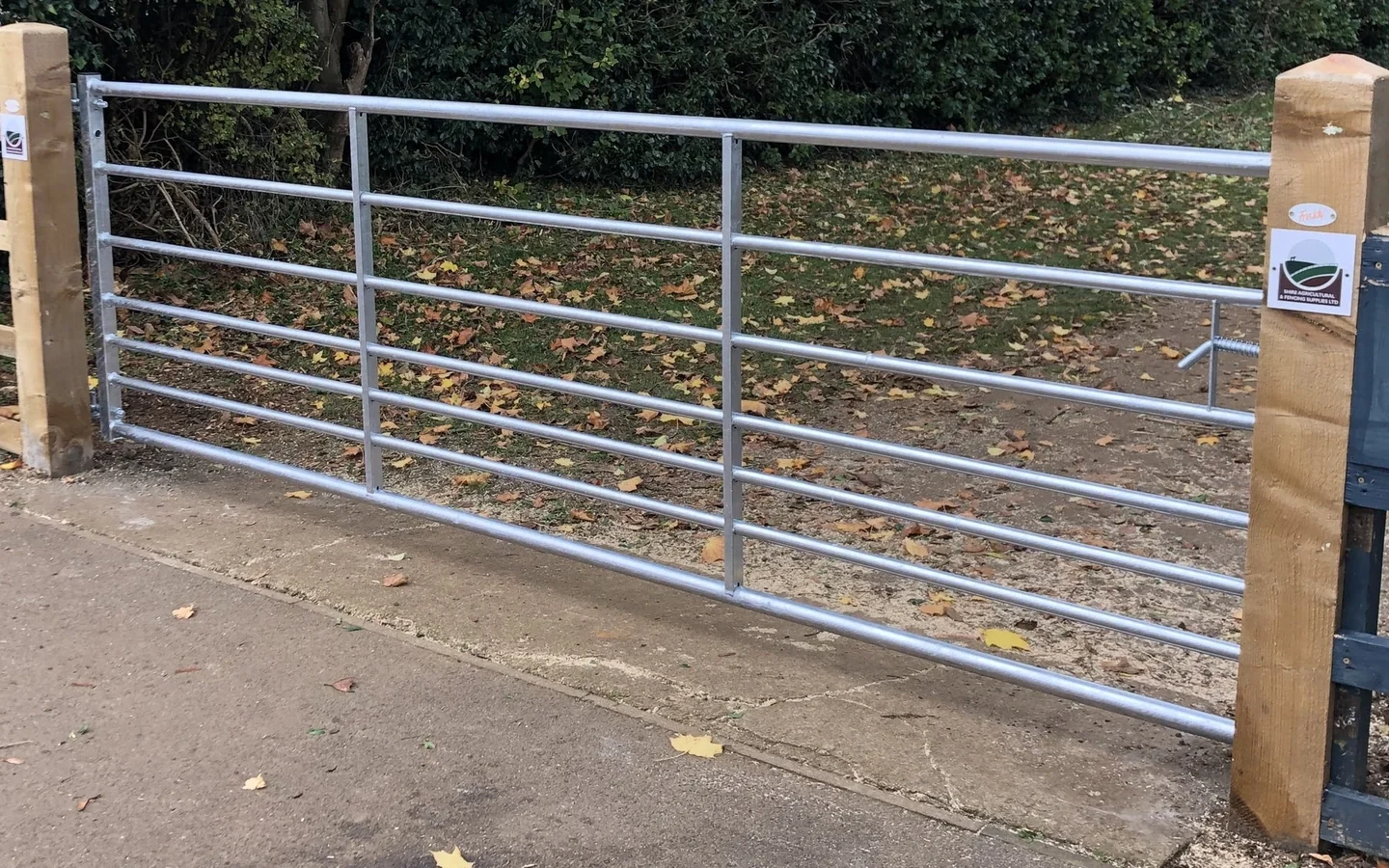
The existing family has a 1,145 mm leaf height and closer lower rail spacing. Nominal 3–16 ft options are available for configuration review. The paired dimensions below come from our selection data; they are not exact conversions from the foot labels.
| Model | Nominal width | Leaf width | Width including posts |
|---|---|---|---|
| KY-FG7-04 | 4 ft | 1,220 mm | 1,568 mm |
| KY-FG7-08 | 8 ft | 2,440 mm | 2,788 mm |
| KY-FG7-12 | 12 ft | 3,660 mm | 4,008 mm |
| KY-FG7-16 | 16 ft | 4,880 mm | 5,228 mm |
Seven rails and closer lower spacing do not establish suitability for every animal. Specify the actual clear gaps and frame wall thickness on the selected drawing. A young-stock gate may require a different lower layout even when its overall width matches.
4. Single leaf or double gate?
A single leaf needs an unobstructed arc and a hanging post designed for its cantilever load. Paired leaves reduce each leaf's span but add a center closing detail, ground restraint and a closing sequence. Compare the complete assemblies rather than assuming two smaller gates can simply be joined together.
The University of Kentucky gate guide discusses opposing leaves for large openings and links gate operation with drainage, post alignment and stops. Its wood-post dimensions are not a foundation design for KUNYU steel posts.
Keep concentrated runoff out of the gateway where possible. Locate stops so a two-way gate cannot fold back into its hinges or post. If a leaf swings toward a road, review the setback and traffic conflict before choosing that opening direction.
5. Read the 5 ft dimension chain correctly
KY-FG7-05 has a 1,525 mm leaf and a 1,873 mm overall assembly width. With two 114.3 mm OD posts, the geometric space between the post faces is approximately 1,873 − 2 × 114.3 = 1,644.4 mm. Hinges, latch parts and the open leaf can reduce the usable passage further.
The existing steel-post detail is 114.3 mm OD × 3 mm wall × 2,000 mm overall length. The hinge post and slotted latch post are different components. Do not subtract the 1,145 mm leaf height from the post length to obtain embedment: ground clearance, hinge levels, soil and foundation design also enter the calculation.
A wider or differently infilled gate needs its own support review. Adding solid sheeting changes wind exposure. Adjustable hinges can correct limited alignment differences; they cannot clear a hillside that rises through the swing arc.
6. Check sag, closing and the supplied hardware
| Problem | Inspect before adjusting | Reason |
|---|---|---|
| Free end drags | Hanging-post movement, hinges and frame distortion | Raising the latch will not repair a moving support |
| Gate swings by itself | Post plumb and hinge-axis alignment | Alignment affects the resting position |
| Latch will not engage | Closing gap, ground contact and matching hardware | Forcing the latch can conceal an installation fault |
| Animals reach through the lower rails | Actual clear openings and animal size | More gate width will not solve an unsuitable rail layout |
For galvanized farm gates, specify coating and weld protection alongside the frame. Send KUNYU each gate's use, required passage, drawing revision and quantity of complete sets: leaf, hinge post, latch post and hardware. Include opening direction, packing and destination for FCL/LCL review. Match the gate to the adjacent woven wire fence and use the loading guide to prepare shipment inputs.