
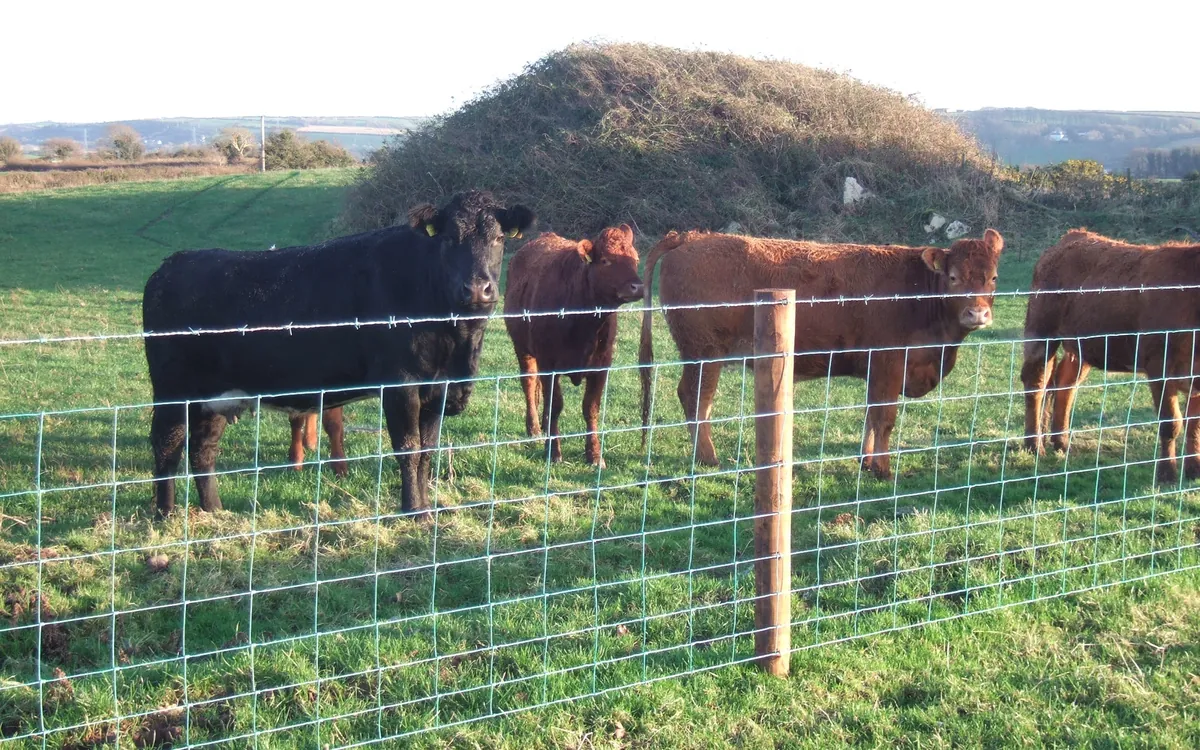
1. Decide whether the run serves cattle, pigs or both
Woven wire fence for cattle and hogs needs a different assessment from a cattle-only boundary. Adult cattle load the upper fence by reaching, rubbing or pushing. Pigs challenge the ground edge and can lift mesh; piglets also need smaller openings. Mark the animal group on each run before choosing the roll.
| Run duty | Primary concern | Useful starting choice |
|---|---|---|
| Cattle pasture boundary | Height, contact and support stability | A correctly braced woven-wire system |
| Cattle and pig shared boundary | The pig can defeat the cattle detail at ground level | Review the complete pig-resistant base and gate detail |
| Piglet enclosure | Openings and gaps at every transition | Smaller openings suited to the youngest group |
| Crowded barnyard or handling pen | Repeated close contact and concentrated loads | Assess purpose-made welded panels or rigid construction |
| Wild-pig exclusion | External pressure and contact with domestic stock | A separate exclusion and herd-protection plan |
UC ANR's livestock table warns that swine can lift or bend woven mesh and recommends pig-specific welded panels among its options. That warning is more useful than assuming a heavy-gauge cattle roll solves every pig enclosure.
2. Understand why the pig-fence bottom changes the design
A tighter top wire does not close a rooting route. Walk the base and mark soft soil, dips, banks, gate thresholds and drains. Look for places where the mesh can be pushed up as well as openings already visible. Restraint must connect the lower barrier to stable supports.
Ontario's outdoor-pig factsheet discusses page wire combined with other measures, including buried mesh and electric offsets. Its adult-pig guidance uses at least 1.5 m fence height and describes a skirt buried 60 cm with a right-angle detail. These are that publication's design recommendations, not a universal instruction for every soil or a KUNYU tested system.
The same factsheet treats piglet openings, adult strength and wild-pig exclusion separately. Its more demanding combined systems show why a short roll marketed as hog fence should not be sold as complete outdoor pig containment.
3. Read the entire mesh pattern
Specify both opening directions. A 6 in stay spacing means the horizontal distance between vertical wires; it does not identify the vertical gap between horizontal wires. Graduated field mesh can have small lower gaps and much larger upper gaps.
In KUNYU's existing nominal 4 ft field-mesh layout, nine vertical intervals are listed as 3.5, 3.5, 4, 4.5, 5, 5.5, 6, 7 and 8 in. They total 47 in and form ten horizontal wires. With a 6 in stay spacing, the lower and upper openings therefore differ substantially. This layout illustrates the selection issue; it does not approve those openings for piglets.
Request the full drawing and inspect gate side gaps, the space below the gate and joins to buildings against the same animal group. Do not test a fit by pushing an animal's head through a sample.
4. Compare woven rolls and rigid panels by construction
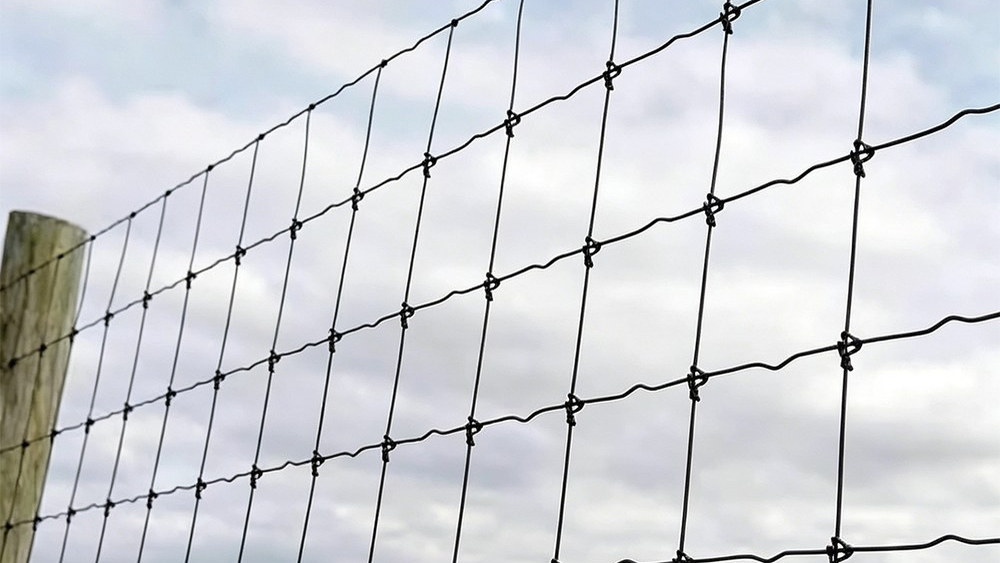
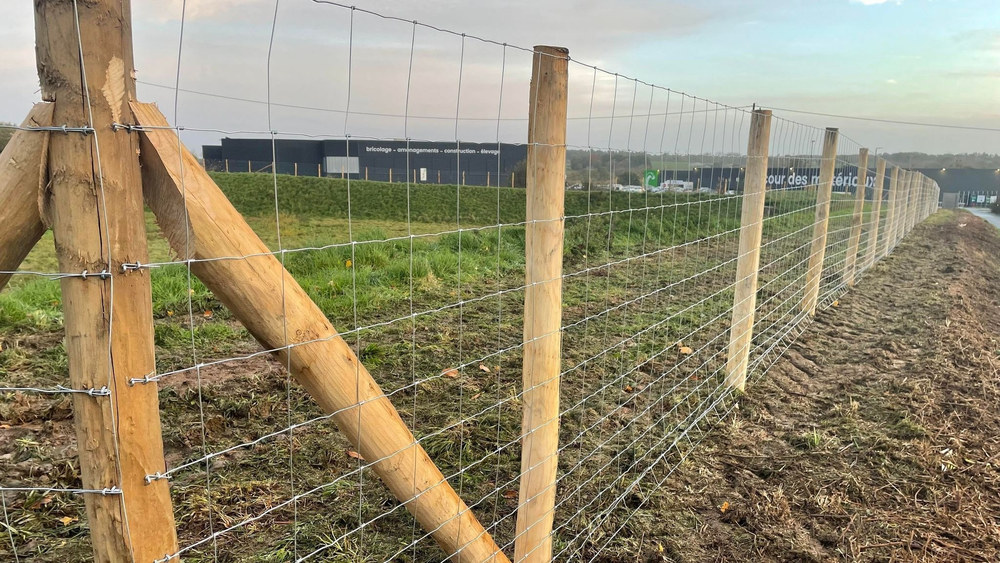
Kencove's woven-wire overview distinguishes fixed-knot and hinge-joint systems. Knot style is one choice; the actual wire schedule, coating, supports and lower restraint still determine the proposed assembly.
| KUNYU selection configuration | Known dimensions | Decision still required |
|---|---|---|
| 842-6-330 fixed knot | 8 line wires; 42 in high; 6 in stay spacing; 330 ft net roll | Full openings and suitability for the animal group |
| 1348-6-330 fixed knot | 13 line wires; 48 in high; 6 in stay spacing; 330 ft net roll | Ground, gate and support design |
| 1561-6-330 fixed knot | 15 line wires; 61 in high; 6 in stay spacing; 330 ft net roll | Different height; not proof of pig resistance |
| Graduated welded hog panel | 16 ft long × 34 in high; 5 ga selection reference | Actual diameter, opening schedule, welds and intended enclosure duty |
The 42 in roll is about 1.067 m high; the 34 in panel is about 0.864 m. Neither reaches the Ontario adult outdoor-pig example's 1.5 m height. A panel can be useful in a different reviewed pen configuration without being interchangeable with that outdoor perimeter design.
5. Use stronger construction where animals crowd
Washington State University's livestock guide separates pasture fencing from panels and heavier construction in high-traffic areas. Plan feeding points and handling entrances so a long boundary roll is not expected to perform as a crowding gate.
At drains, account for water flow, debris and inspection access; a rigid mesh patch can block flow and be undermined. At gates, provide a matching lower barrier and a latch that closes consistently. Check these transitions before ordering extra fence height.
6. Compare other types of fencing by the failure they address
Barbed wire can be part of a cattle boundary, but it does not close the spaces that small pigs can pass through. Adding a top strand to a cattle fence does not correct an open bottom. If a design includes barbed wire, assess animal contact and handling at that location rather than treating it as a substitute for suitable mesh.
Compare fencing solutions for each run. Flexible rolls suit long boundaries where the support and tensioning plan can be installed. Rigid panels create shorter modules with different support connections. A gate closes an access point but adds hinge, latch and ground clearances. Choosing a stronger material in one part does not remove a gap in another part.
| Observed problem | First detail to inspect | Change to assess |
|---|---|---|
| Piglets pass through | Clear openings at animal height, including beside posts | Closer suitable mesh or a separately specified lower barrier |
| Pigs lift the bottom | Base restraint, soft ground and erosion | A designed ground detail, not simply more top tension |
| Cattle deform a busy entrance | Animal contact, gate frame, latch and supporting posts | A gate or panel assembly designed for that duty |
| Mesh sags across a run | Braces, attachments, post movement and strand damage | Repair the cause before adjusting tension |
Use these observations to revise the drawing and bill of materials. For a replacement order, record the failed section, animal group, opening pattern and fixing detail. A photograph of the damage helps locate the problem, but it does not establish wire strength or a tested containment rating. Keep the final enclosure decision with the farm's responsible designer and livestock manager.
7. Turn the plan into quantities and checks
Example only: 600 ft of cattle boundary plus a separate 200 ft pig enclosure totals 800 ft, but the two runs should not automatically share one SKU. Calculate roll needs for each approved configuration, then add connection and termination allowances. Count posts, braces, gate sets and base components separately.
Before use, inspect attachments, wire ends, the lower edge, gate closure and ground gaps with the livestock manager. Recheck after erosion or animal damage. For replacement material, retain the original wire schedule and drawing revision so a similar product name does not conceal a different layout.
Send KUNYU the animal groups, run plan and approved dimensions for fixed-knot, hinge-joint or panel supply review. FCL and LCL quantities can be assessed by item. If the design needs an electric component, specify it as a separate system supplied and installed by the appropriate specialist.
 Fixed Knot Fence
 Hinge Joint Field Fence