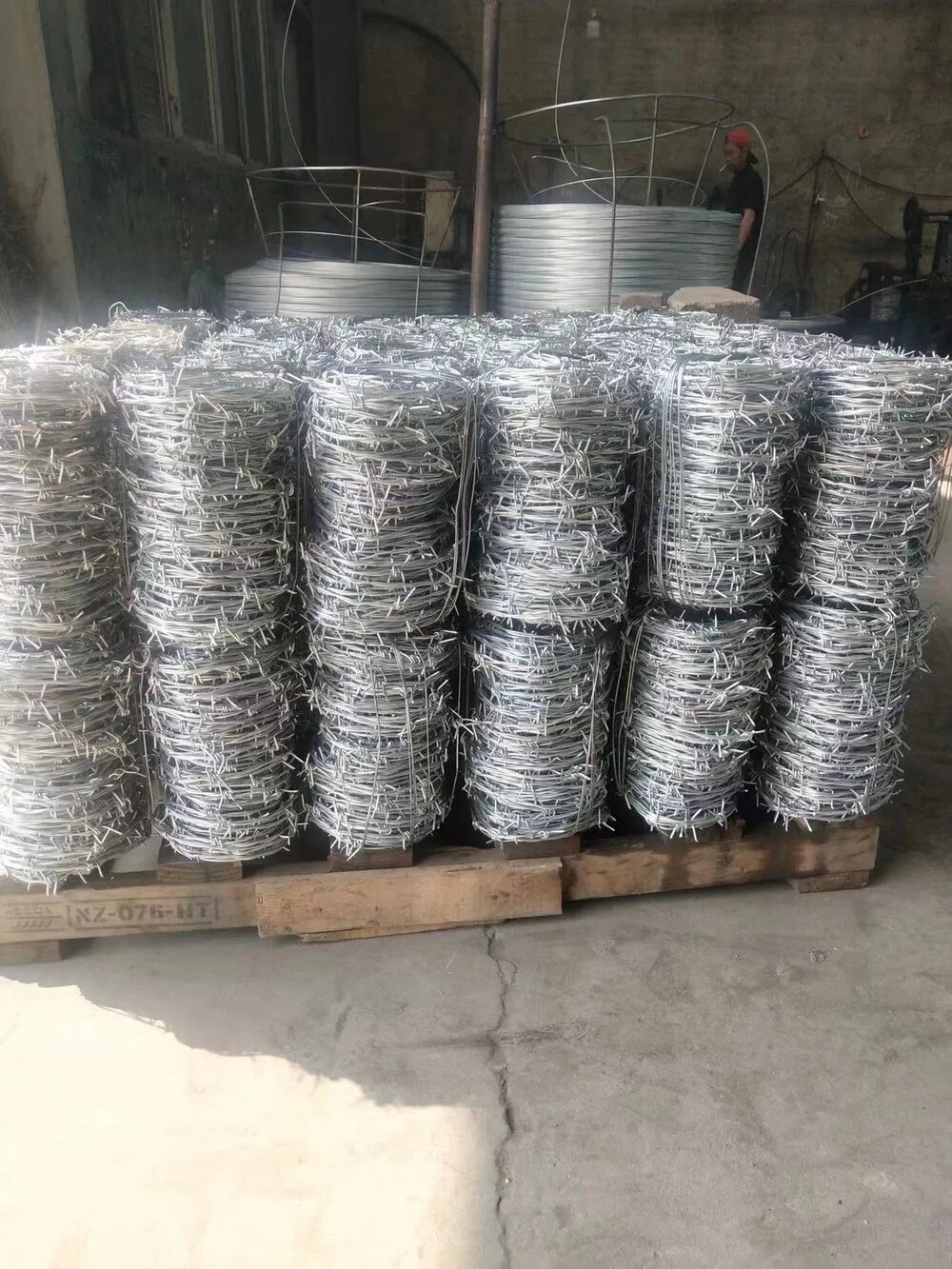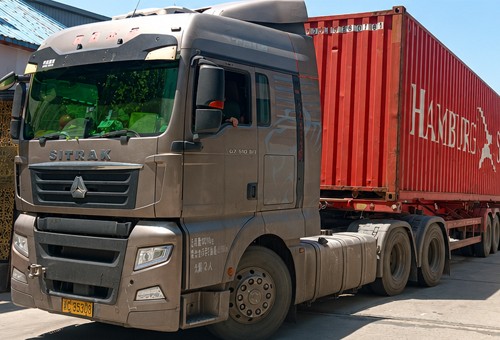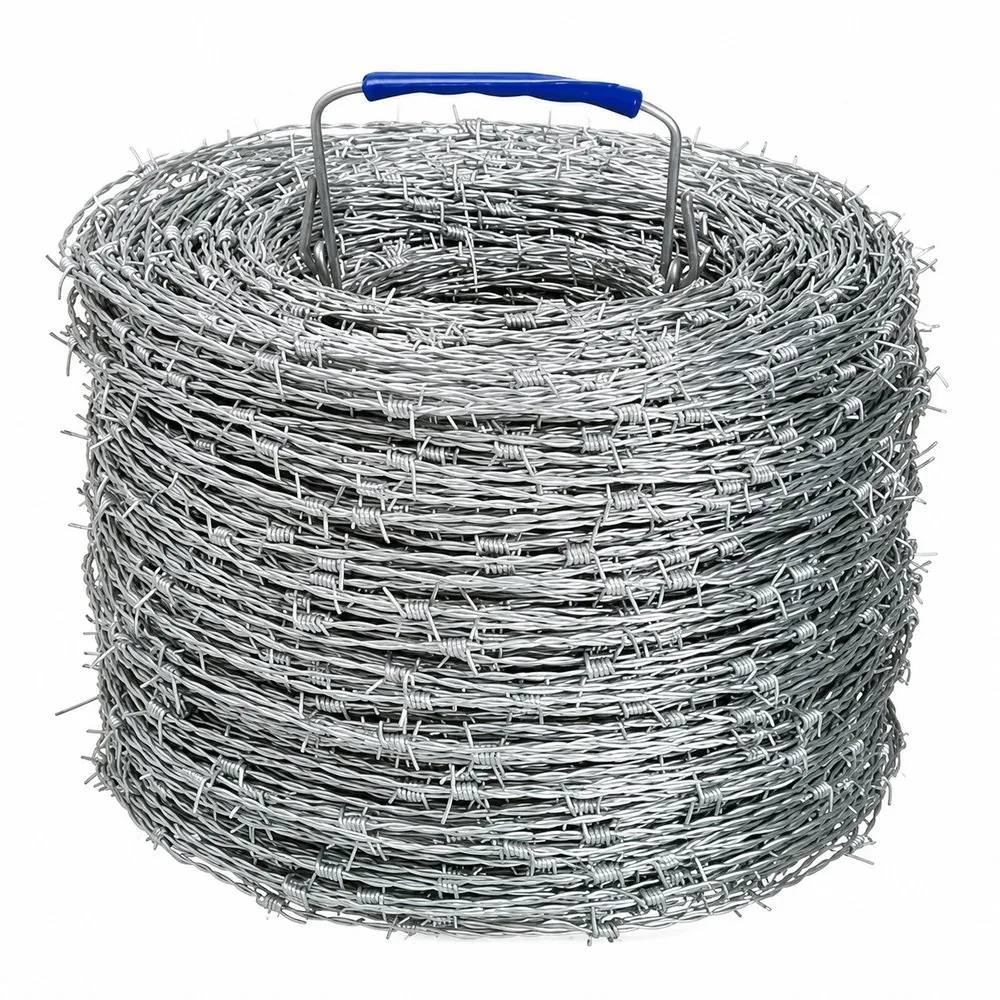
This specification guide is written for importers, distributors, farm stores and fencing contractors comparing full-coil or container quotations. It covers the two common choices in KUNYU FENCING's wholesale barbed wire range: 12.5 gauge low-carbon wire and 15.5 gauge high-tensile wire.
1. 12.5 Gauge vs 15.5 Gauge at a Glance
| Buying Point | 12.5 Gauge Low Carbon | 15.5 Gauge High Tensile |
|---|---|---|
| Approximate diameter | 2.5 mm | 1.7 mm |
| Relative wire thickness | Thicker | Thinner |
| Steel behavior | More flexible and easier to hand form | Higher tensile steel; designed to hold line tension |
| Handling and repair | Easier to bend, tie and splice with traditional methods | Requires correct tensioning, bracing and suitable tools |
| Weight per equal length | Higher | Lower |
| Typical use | Traditional cattle, pasture and rural boundary fence | Long cattle, ranch and rangeland fence runs |
| Common wholesale coil | 1320 ft / 402.3 m | 1320 ft / 402.3 m |
| Available barb formats | 2-point or 4-point | Commonly 4-point; confirm the order |
The table describes common product configurations, not an automatic performance ranking. Final performance depends on documented steel properties, finished wire construction and installation.
2. Why the Lower Gauge Number Means Thicker Wire
Wire gauge runs in the opposite direction from diameter: the lower number is the thicker wire. In the configurations compared here, 12.5 gauge is about 2.5 mm, while 15.5 gauge is about 1.7 mm. Because metal area rises quickly as diameter increases, a 12.5 gauge coil normally contains substantially more steel than a 15.5 gauge coil of the same length.
This affects coil weight, handling, container loading and purchase price. It does not, by itself, prove that the thicker product will perform better on an installed fence line.
3. Thickness and Tensile Strength Are Different Specifications
Gauge measures diameter. Tensile strength describes how the steel behaves under load. Traditional 12.5 gauge barbed wire is often produced from low-carbon steel, which is comparatively easy to bend and repair. A 15.5 gauge product may use high-tensile steel, giving a thinner strand the ability to maintain useful fence-line tension.
For this reason, buyers should ask suppliers to state wire diameter, steel type, tensile-strength range and breaking-load data on the same quotation. Comparing only “12.5 ga” with “15.5 ga” leaves out the specification that explains the steel's mechanical behavior.
4. Which Specification Is Better for Cattle Fencing?
Both can be used for cattle fence systems when the complete fence is designed and installed correctly.
- Choose 12.5 gauge low-carbon 4-point wire when the market expects a heavy traditional coil, installers prefer easy field forming and splicing, or repair simplicity is important.
- Choose 15.5 gauge high-tensile 4-point wire for long, properly braced ranch lines where installers are equipped to tension high-tensile wire correctly.
- Choose 2-point wire when the project or local market specifies a less aggressive barb pattern, including some pasture divisions or top strands above woven wire.
Animal pressure, fence-line length, terrain, post spacing, corner bracing and installer experience matter as much as wire gauge. For a broader system choice, see barbed wire vs woven wire fence.
5. Gauge Does Not Decide 2-Point vs 4-Point
Gauge and barb point count are separate ordering decisions. Gauge describes the main strand diameter. Two-point or four-point describes the number of sharp tips at each barb location. A complete description should read like this:
- 12.5 ga low carbon · 4 point · 5 in spacing · 1320 ft · Class 3 galvanized
- 15.5 ga high tensile · 4 point · 5 in spacing · 1320 ft · Class 3 galvanized
Without every field, two quotations may look similar while describing materially different products.
6. Coating Can Matter More Than a Small Price Difference
Outdoor service life depends strongly on the galvanized coating and environment. Buyers should request the coating class or zinc weight rather than accepting the word “galvanized” by itself. KUNYU FENCING's principal 12.5 and 15.5 gauge export configurations can be quoted with Class 3 galvanized coating; confirm the coating with the exact model, order quantity and destination market.
When comparing landed cost, divide the quotation by verified linear length and check that coating, wire type and barb construction match. A lower-cost coil with lighter zinc or shorter actual length is not an equal comparison.
7. What Importers Should Put in the RFQ
| RFQ Field | Example | Why It Matters |
|---|---|---|
| Gauge and diameter | 12.5 ga / approx. 2.5 mm | Locks the amount of steel and avoids gauge-only ambiguity |
| Steel type | Low carbon or high tensile | Changes handling and tension behavior |
| Tensile / breaking load | Supplier to document | Allows a real mechanical comparison |
| Barb construction | 4 point, 5 in spacing | Defines deterrence pattern and material use |
| Coil length | 1320 ft / 402.3 m | Lets buyers compare price per foot or meter |
| Coating | Class 3 galvanized | Major factor in corrosion protection and cost |
| Packing | Handles, tags, pallet or buyer label | Affects handling, resale and container planning |
| Trade details | Quantity, destination port, FOB or CIF | Required for a usable wholesale quotation |
8. Recommended Buying Decision
For distributor stock, it is reasonable to carry more than one specification because the two products serve different installer habits and price positions. If the order must be limited to one model, start with the standard already accepted by your market and obtain a sample or full written specification before changing gauge or steel type.
For long-run cattle and ranch projects with trained installers, 15.5 gauge high-tensile 4-point wire is the efficient system choice. For a traditional heavy product that is easier to hand work, compare the 12.5 gauge 4-point wire and 12.5 gauge 2-point wire.
9. Frequently Asked Questions
Is 12.5 gauge or 15.5 gauge barbed wire thicker?
12.5 gauge is thicker at approximately 2.5 mm. A typical 15.5 gauge strand is approximately 1.7 mm.
Is 15.5 gauge high-tensile wire weaker?
Not necessarily. It is thinner, but high-tensile steel changes its load behavior. Compare documented tensile strength and breaking load, not gauge alone.
Which gauge is better for cattle?
15.5 gauge high tensile suits long, properly tensioned ranch lines. Traditional 12.5 gauge is heavier and easier to bend, splice and repair. Select according to system design and installer practice.
Does four-point mean the wire is thicker?
No. Point count describes the barb. Gauge describes the main wire diameter.
What coil length should quotations use?
A common export coil is 1320 ft, approximately 400 m. Compare quotations at the same verified linear length.
What must be confirmed before ordering?
Gauge, diameter, steel type, tensile or breaking-load data, barb points, spacing, coating, coil length, reference weight, packing, quantity and destination port.
Compare 12.5 and 15.5 Gauge Factory Quotations
Send your target market, cattle or boundary application, preferred barb points, spacing, coating, coil quantity and destination port. KUNYU FENCING can quote both specifications on the same commercial basis for a clear landed-cost comparison.