All figures below are practical planning references based on common specifications. Exact loading quantity always depends on the confirmed wire diameter, height, roll length and packing method. Check our Resources Center for more sourcing guides.
1. Container Basics: Weight Limit Comes First for Fence Products
Before estimating quantities, buyers should understand the working limits of standard containers. For dense steel products, the payload limit is usually reached long before the container looks full.
| Container Type | Internal Space (approx.) | Typical Payload for Fence Cargo | Best For |
|---|---|---|---|
| 20ft (20GP) | 33 CBM | Approx. 25-27 tons | Heavy products: fence rolls, T posts, barbed wire |
| 40ft (40GP) | 67 CBM | Approx. 26-28 tons | Mixed loading, lighter or bulky products |
| 40ft High Cube (40HQ) | 76 CBM | Approx. 26-28 tons | Bulky items: fence panels, weed fabric, mixed accessories |
Note that road weight regulations at the destination country can be stricter than the container rating. Buyers in some regions request a lower loading weight (for example 21-24 tons) so the container can move legally by truck after arrival. Always confirm the local weight limit before finalizing the loading plan.
2. How Many Hinge Joint / Field Fence Rolls Fit in a Container?
For woven field fence such as hinge joint fence and fixed knot fence, roll weight depends on fence height, roll length and wire diameter. A common 1.2m x 100m hinge joint roll typically weighs around 30-45 kg depending on specification, so a 20ft container by weight loads roughly:
| Typical Specification | Approx. Roll Weight | Approx. Quantity per 20ft |
|---|---|---|
| Hinge joint 0.8m x 50m, light duty | 15-20 kg | 1,300-1,700 rolls |
| Hinge joint 1.2m x 100m, standard | 30-40 kg | 650-850 rolls |
| Hinge joint 1.5m x 100m, standard | 40-50 kg | 500-650 rolls |
| Fixed knot 1.5m x 100m, high tensile heavy duty | 50-70 kg | 380-500 rolls |
Because a 20ft container is already at maximum weight with these quantities, upgrading to a 40ft container usually does not double the quantity — it only adds space, not payload. That is why heavy fence rolls are most often shipped in 20ft containers, unless the buyer plans mixed loading with lighter goods.
See our high tensile hinge joint fence product page for available heights, roll lengths and wire specifications.
3. How Many Welded Wire Fence Rolls Fit in a Container?
Galvanized welded wire fence rolls are lighter per roll than woven field fence, so space utilization matters more. Rolls can be loaded vertically or horizontally, loose or on pallets.
| Typical Specification | Approx. Roll Weight | Approx. Quantity per 20ft |
|---|---|---|
| Welded wire 4ft x 50ft, 14 gauge, 2x4 inch mesh | 20-25 kg | 1,000-1,300 rolls |
| Welded wire 4ft x 100ft, 14 gauge, 2x4 inch mesh | 40-50 kg | 500-650 rolls |
| Welded wire 5ft x 100ft, 12.5 gauge | 55-70 kg | 380-480 rolls |
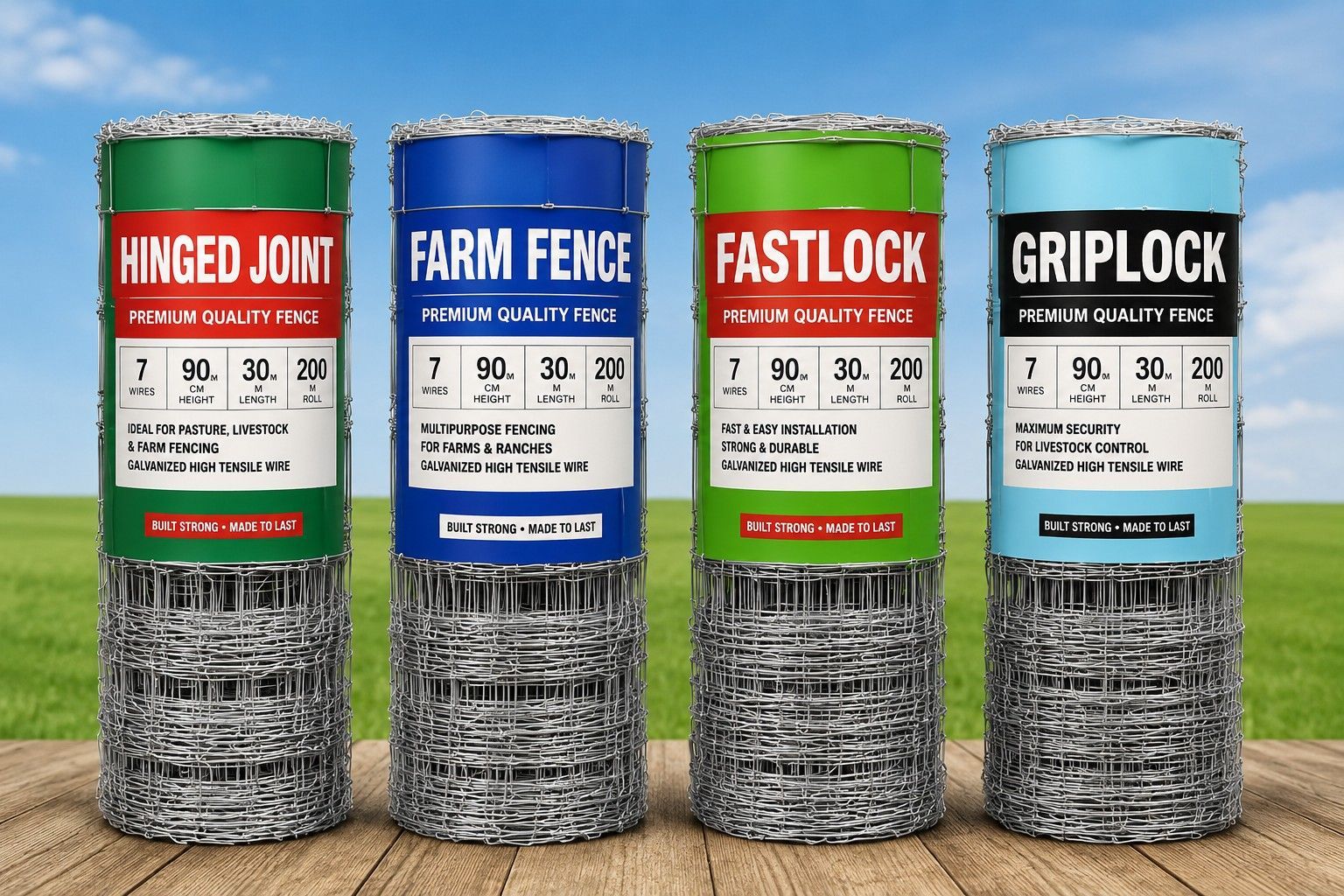
For retail-oriented distributors, welded wire rolls are often packed with a paper or plastic sleeve plus a printed label, and stacked on pallets for direct store distribution. Details of the popular 4ft x 100ft specification are on our galvanized welded wire fence roll product page.
4. How Many Steel T Posts Fit in a Container?
Steel T posts are the densest cargo in a farm fence shipment. Quantity is calculated almost entirely by weight. The common US-style studded T post is specified by weight per foot (for example 1.25 lb/ft) and length (5ft, 5.5ft, 6ft, 6.5ft, 7ft, 8ft).
| T Post Specification | Approx. Weight per Piece | Approx. Quantity per 20ft (25-27 t) |
|---|---|---|
| 1.25 lb/ft x 5ft | 2.8-3.0 kg | 8,500-9,500 pcs |
| 1.25 lb/ft x 6ft | 3.4-3.6 kg | 7,000-8,000 pcs |
| 1.33 lb/ft x 6ft | 3.6-3.9 kg | 6,500-7,500 pcs |
| 1.33 lb/ft x 8ft | 4.8-5.2 kg | 4,800-5,600 pcs |
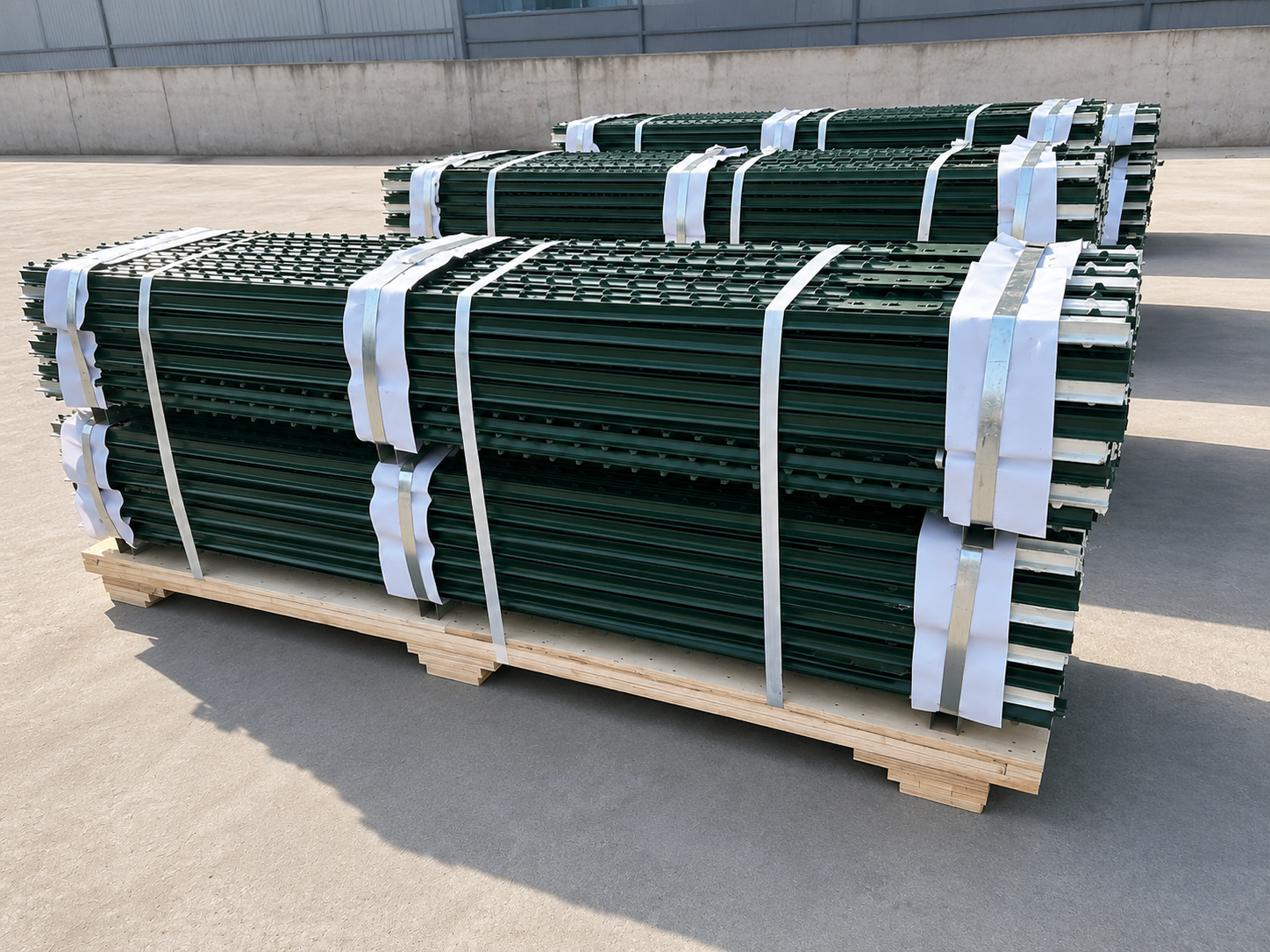
T posts are usually packed in bundles of 5 or 10 pieces with steel strapping, or stacked on pallets for markets that unload with forklifts. Pallet packing reduces quantity slightly but saves significant unloading labor at destination. See our green steel T post product page and the T post selection guide for specification details.
5. Mixed Container Loading: Build a Complete Farm Fence Program in One Shipment
Most farm fence distributors do not sell a single product. Their customers buy the fence roll, the posts, the barbed wire and the clips together. Mixed container loading lets an importer test or restock a complete product line in one container instead of committing a full container to each item.
A practical mixed 20ft loading plan often looks like this:
| Product | Example Quantity | Approx. Weight Share |
|---|---|---|
| Hinge joint fence 1.2m x 100m | 300 rolls | ~11 tons |
| Steel T post 6ft, 1.25 lb/ft | 2,500 pcs | ~9 tons |
| Barbed wire 2.0mm, 400m coils | 120 coils | ~4 tons |
| Fence clips / accessories | As required | ~1 ton |
Loading order also matters: heavy T post bundles go on the floor and toward the front, fence rolls stack above and behind, and light accessories fill remaining gaps. A supplier experienced in mixed loading will send a loading plan and loading photos before the container leaves the factory.
6. Packing Methods and How They Affect Loading Quantity
Packing is a trade-off between container utilization and handling convenience at destination. The right choice depends on how the buyer sells: wholesale to fencing contractors, or retail through farm supply stores.
| Packing Method | Loading Efficiency | Best For |
|---|---|---|
| Loose rolls / bundles | Highest quantity per container | Wholesale buyers with manual unloading labor |
| Pallet packing | 5-10% less quantity | Distributors using forklift unloading and warehouse racking |
| Sleeve + printed label per roll | Minor space impact | Retail distribution and private label programs |
| Private label / OEM packing | Depends on design | Brand owners and chain store supply |
7. From Loading Quantity to Landed Cost
Container loading quantity is the bridge between FOB unit price and real landed cost. Two quotations with the same unit price can produce different landed costs if one supplier loads 10% more product in the same container through better packing and loading planning.
When comparing suppliers, buyers should ask for: quantity per container for the exact specification, gross and net weight, packing method, and whether the supplier provides a loading plan and loading supervision photos. These details are as important as the unit price itself. For a full cost discussion, see how much a weak farm fence really costs your business.
8. RFQ Checklist for a Container Loading Calculation
To get an exact loading quantity and a fast FOB / CIF quotation, include the following information in your inquiry:
| RFQ Item | Buyer Should Provide |
|---|---|
| Product Type | Hinge joint fence, fixed knot fence, welded wire fence, T post, barbed wire, etc. |
| Specification | Height, roll length, wire diameter, mesh opening or stay spacing, post length and weight per foot |
| Surface Finish | Galvanized coating level, painted, PVC coated or custom requirement |
| Packing Requirement | Loose, bundles, pallets, sleeve, label or private label |
| Container Preference | 20ft, 40ft, 40HQ, or ask the supplier to recommend |
| Mixed Loading | List all products you want to combine in one container |
| Destination Port | Required for CIF quotation and local road weight limits |
| Target Quantity | Trial container, annual volume or program supply |
9. FAQ About Fence Container Loading
1. How many fence rolls fit in a 20ft container?
A 20ft container usually loads around 24-27 tons of fence rolls by weight limit, not by space. For hinge joint field fence, that is often roughly 600 to 900 rolls depending on fence height, roll length, wire diameter and packing method. The exact quantity must be calculated from the confirmed specification.
2. How many steel T posts fit in a 20ft container?
Steel T posts are heavy, so a 20ft container is normally limited by weight to about 25-27 tons. For a common 1.25 lb/ft studded T post at 6ft length, that is roughly 7,000 to 8,500 pieces. Lighter or shorter posts load more pieces; heavier posts load fewer.
3. Should I choose a 20ft or 40ft container for fence products?
Heavy products like fence rolls, T posts and barbed wire usually reach the weight limit before filling a 40ft container, so a 20ft container is often more economical for a single heavy product. A 40ft or 40HQ container makes sense for lighter, bulky products or for mixed loading of fence rolls with accessories.
4. Can I mix fence rolls, T posts and barbed wire in one container?
Yes. Mixed container loading is common for farm fence importers. A typical plan combines field fence or welded wire fence rolls, steel T posts, barbed wire and fence clips in one container to build a complete product line and reduce sourcing complexity.
5. What information is needed to calculate container loading quantity?
Provide product type, fence height, roll length, wire diameter, mesh opening or stay spacing, surface finish, packing method (loose rolls, pallets or bundles), destination port and whether mixed loading is required. The supplier can then calculate exact loading quantity and quote FOB or CIF.
6. Is pallet packing worth the extra cost for fence rolls and T posts?
Pallet packing slightly reduces loading quantity but speeds up unloading, reduces labor cost at destination and protects products for retail distribution. Many distributors in North America, Europe and Oceania request pallet packing for this reason.
Get an Exact Container Loading Plan and Quotation
Send us your product list, specifications, packing requirement and destination port. KUNYU FENCING will calculate the exact loading quantity for a 20ft, 40ft or mixed container, and reply with an FOB / CIF quotation plus a recommended loading plan within 24 hours.