

Barbed Wire
Barbed Wire Range
Galvanized and high tensile barbed wire in 12.5, 14 and 15.5 gauge with 2 or 4 point barbs for cattle, pasture and rural boundaries.
12.5-15.5 Gauge2 or 4 PointClass 3 Zinc
This page is for complete barbed wire fence system orders: wire coils, steel T posts, clips and fittings. If you need wire coils only, compare the gauge and barb options in our wholesale barbed wire manufacturer range. KUNYU FENCING manufactures both wire and posts, so complete fence supplies can be quoted and loaded as one order rather than sourced separately. The wire range covers 12.5, 14 and 15.5 gauge in galvanized and high tensile constructions, with 2 or 4 point barbs and adjustable barb spacing, supplied in coils including the 1320 ft quarter-mile size. Post support runs from 6 to 10 ft studded steel T posts with anchor plates. All wire is available in Class 3 galvanized or Zn-Al coating for outdoor corrosion resistance, quoted factory-direct against your specification, quantity and destination port with mixed-container loading.
8 products available for bulk order. Every item is quoted factory-direct against your specification, quantity and destination port.
Galvanized and high tensile barbed wire in 12.5, 14 and 15.5 gauge with 2 or 4 point barbs for cattle, pasture and rural boundaries.
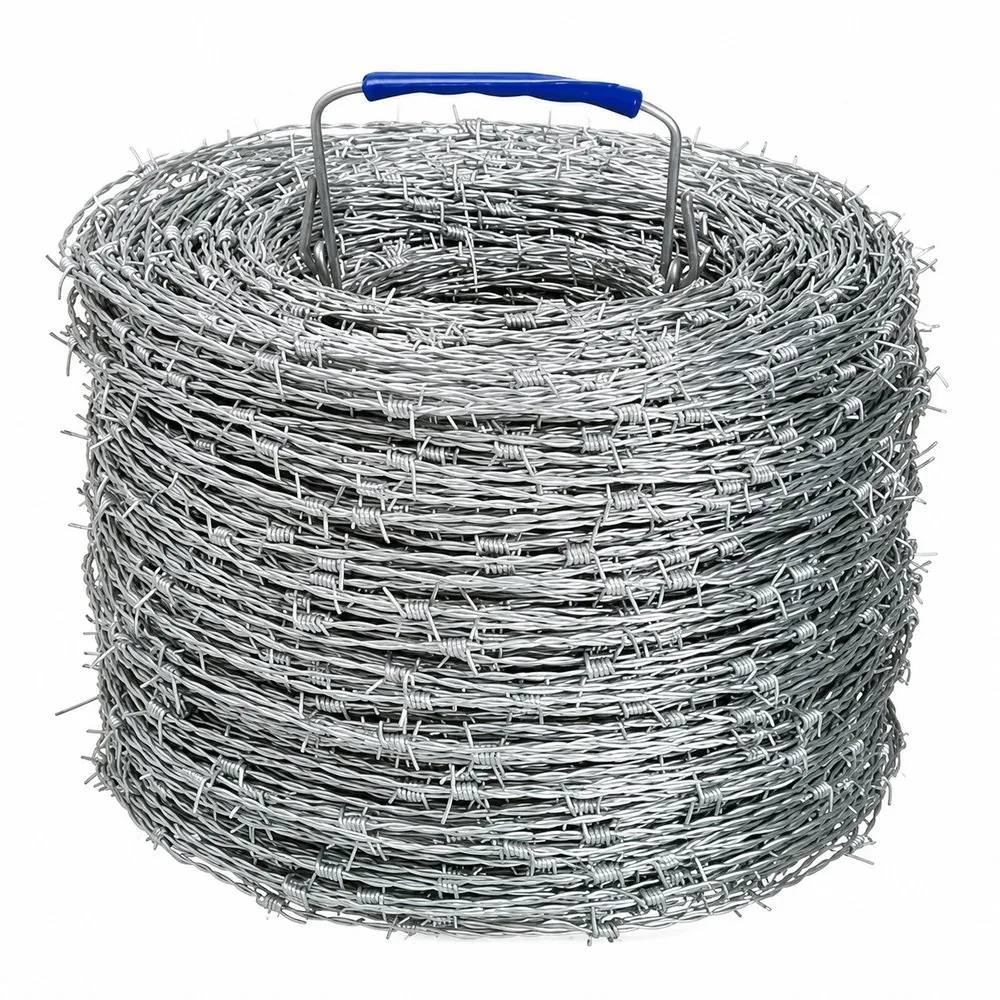
High Tensile Barbed Wire
4-point cattle and ranch barbed wire with 5 in barb spacing, 1320 ft coil and Class 3 galvanized finish.

High Tensile Barbed Wire
4-point high-tensile barbed wire with 5 in spacing and 1320 ft coils; coating level and packing are confirmed with quotation.

Heavy low-carbon galvanized wire for cattle, pasture and rural boundary fence specifications.

Traditional two-point wire for farm boundaries, pasture divisions and woven-wire topping strands.

Q235 studded T posts for fencing · green / galvanized / powder coated · bundle & pallet packing, MOQ 1,000

6 ft studded Q235 steel fence post with anchor plate and RAL 6005 green coating for farm and livestock fencing.

96 in. studded Q235 post with RAL 6005 green coating for deer, vineyard, orchard and tall boundary fencing.
Send the fence type, height, wire count, stay spacing, gauge, roll length, coating, total quantity, packing preference and destination port. For project orders send the total fence run length instead and it will be converted into rolls, posts and wire.
Barbed wire is quoted on five variables. Confirm each one and the coil count follows from the fence run length and strand count.
| Variable | Common options | What it changes | View range |
|---|---|---|---|
| Wire gauge | 12.5, 14 and 15.5 gauge | Heavier gauge resists breakage and animal pressure; lighter gauge lowers coil weight and freight per coil | 12.5 Gauge 4 Point |
| Construction | Galvanized (soft) or high tensile | High tensile holds tension and resists sagging over long runs; soft wire is easier to handle and splice | 15.5 Gauge High Tensile |
| Barb points | 2 point or 4 point | 4 point gives a stronger deterrent for cattle boundaries; 2 point is lighter and cheaper per foot | View Barbed Wire |
| Coating | Class 3 galvanized or Zn-Al | Class 3 is the outdoor standard; Zn-Al is specified for coastal and high-rainfall environments | View Barbed Wire |
| Coil length | 400 m and 1320 ft (quarter mile) | Sets the coil count for a given fence run and the number of splices in the line | 1320 ft Coils |
| Post support | 6, 8 and 10 ft studded steel T posts | Post length follows fence height and soil; spacing sets the post count per mile | View Steel T Posts |
Barbed wire fence is planned by strand count and post spacing, not by roll count. These are the figures used to convert a fence run into a purchase order.
A cattle boundary normally runs 4 to 5 strands. Multiply the fence run length by the strand count to get total wire footage, then divide by the coil length to get the coil count.
A 1320 ft coil covers a quarter mile of a single strand. A 5-strand mile of fence therefore takes about 20 coils of 1320 ft, before any allowance for splices and corner wraps.
At 10 ft post spacing a mile takes about 528 posts, at 8 ft about 660 posts, and at 12 ft about 440 posts. Barbed wire runs can open wider than woven wire because there is no fence panel to support.
Post length is chosen from fence height plus the driven depth. A 4 to 5 strand cattle fence normally uses 6 or 7 ft posts, with 8 ft specified for taller runs or soft ground.
A 20 ft container carries approximately 25 to 27 tons. Barbed wire coils are dense, so wire is usually combined with lighter fence rolls to fill the volume before hitting the weight limit.
Wire, posts and clips ship together as standard. A typical mixed load combines around 120 coils of 400 m barbed wire at about 4 tons with fence rolls and T posts to fill the allowance.
Gauge, barb, quantity and shipping answers for buyers sourcing barbed wire fence supplies in bulk.
12.5 gauge is the general-purpose choice for cattle and rural boundaries and is the most widely stocked. 15.5 gauge high tensile is lighter per foot but holds tension better over long runs, which lowers freight cost per foot of fence. 14 gauge sits between the two. Heavier gauge resists breakage where animals push hard on the line.
The point count is the number of barb wires twisted at each barb. 4 point gives a stronger deterrent and is normal on cattle boundaries and perimeter runs. 2 point is lighter and cheaper per foot and is used where the wire is mainly a visual and light physical barrier or a topping strand above a woven wire fence.
Multiply the fence length by the strand count. A 5-strand mile is 26,400 ft of wire, which is about 20 coils of 1320 ft before allowing for splices and corner wraps. A 4-strand mile is about 16 coils. Send the run length and strand count and the coil count can be converted for you.
About 528 posts at 10 ft spacing, 660 at 8 ft and 440 at 12 ft. Barbed wire can run wider spacing than woven wire fence because there is no fence panel to support, but tighter spacing holds line tension better on rolling ground and at corners.
High tensile wire holds tension and resists sagging after installation, so it suits long boundary runs and wider post spacing. Soft galvanized wire is easier to handle, splice and re-tension by hand, which suits shorter runs and repair work. Both are supplied in Class 3 galvanized coating.
Barbed wire is quoted by coil and by total weight, and steel T posts start at 1,000 to 3,000 pieces depending on length and weight grade. Because wire is dense cargo it is normally combined with fence rolls in the same container, so send the full product mix and the quantity can be confirmed against the container allowance.
Yes, and it is the normal way to load. Wire is heavy and fence rolls are bulky, so combining them fills both the weight and the volume of a container. A typical 20 ft mixed load combines around 120 coils of 400 m barbed wire, 300 rolls of woven wire fence and 2,500 pieces of 6 ft T posts.
Class 3 galvanized is the standard specification for outdoor barbed wire and gives markedly longer service life than light galvanized wire. Zn-Al zinc-aluminium coating is specified for coastal, high-rainfall and other heavier corrosion environments. Both are available across the gauge range.
Use these technical guides to narrow the specification before requesting a factory quotation.
The same factory supplies the rest of the range. Most buyers combine two or three categories in one container to fill the weight allowance.
Barbed Wire Buying Guide
Compare barb format, quotation details, coil basis and the questions distributors should confirm before ordering.
Read the Buyer Guide