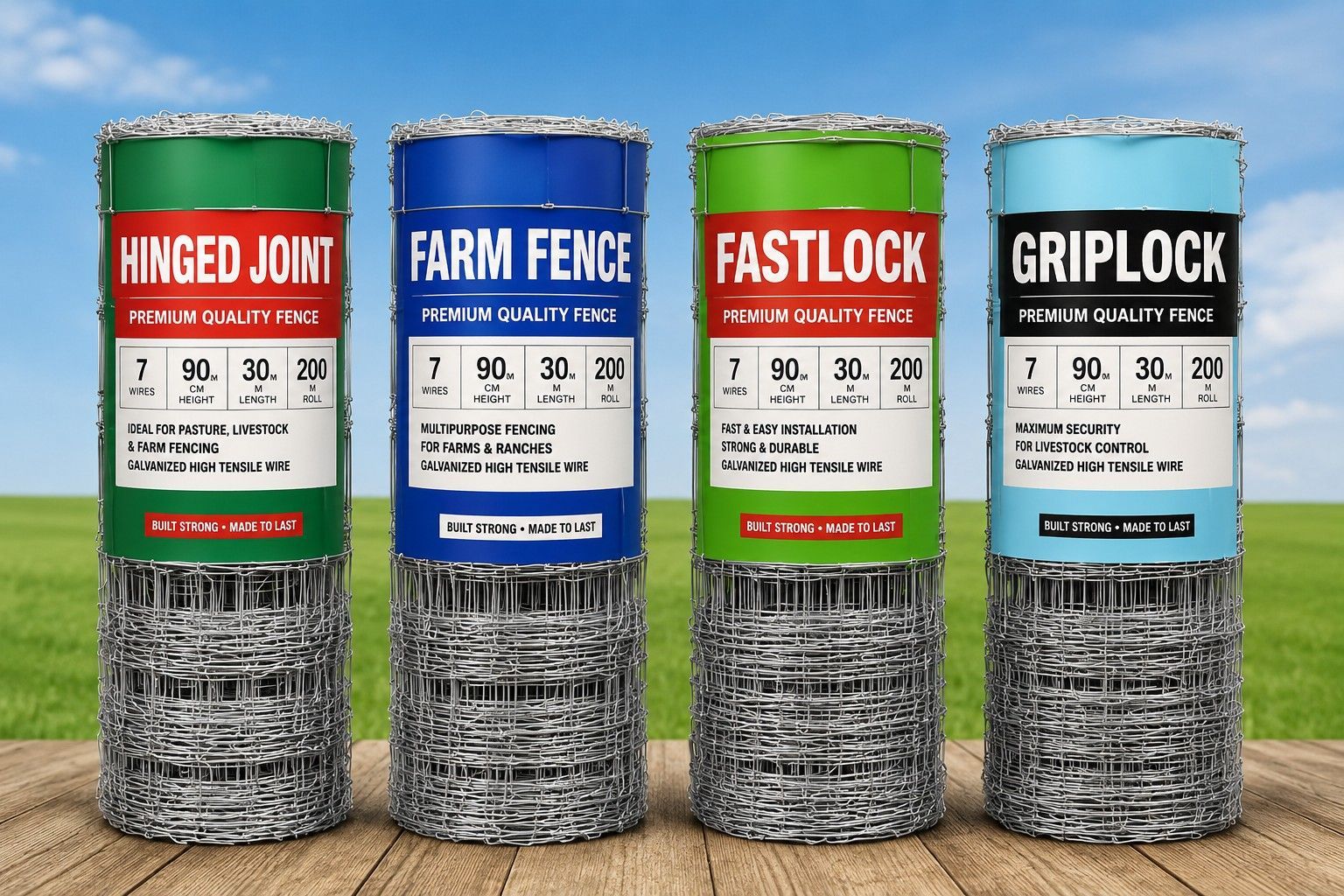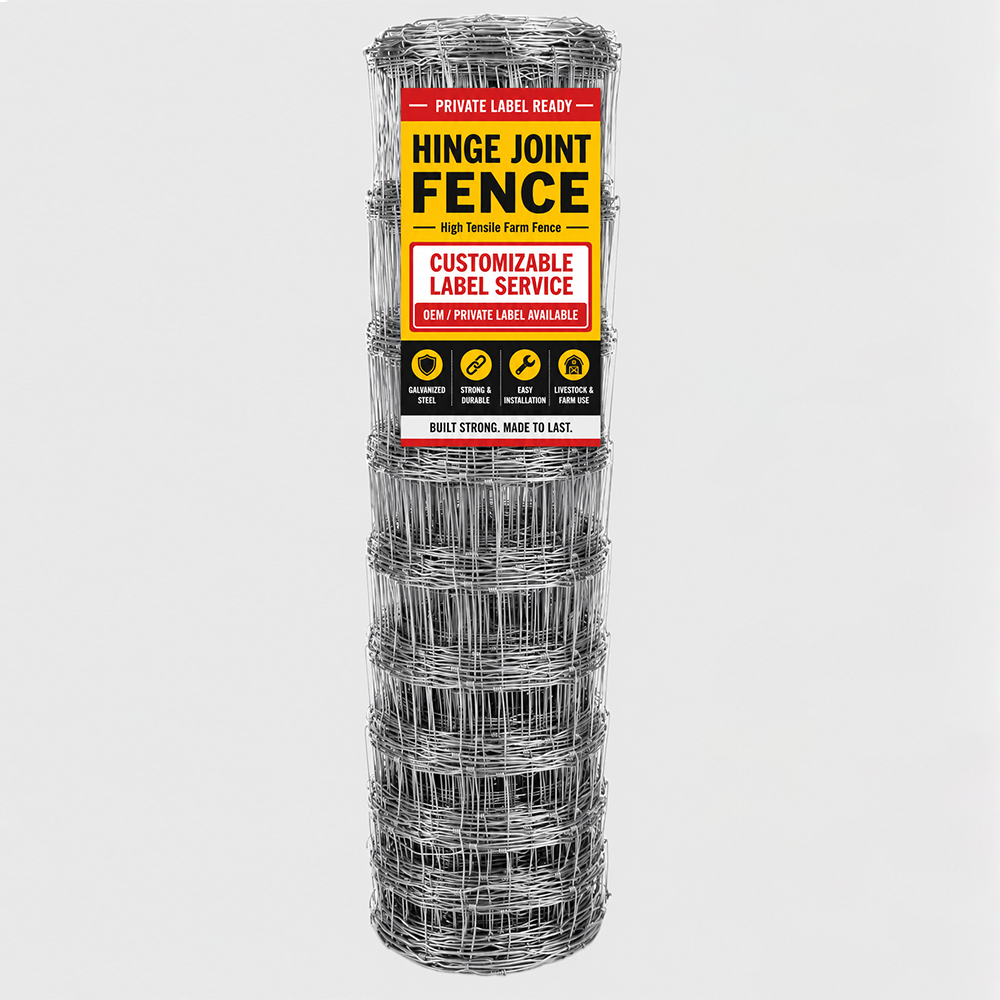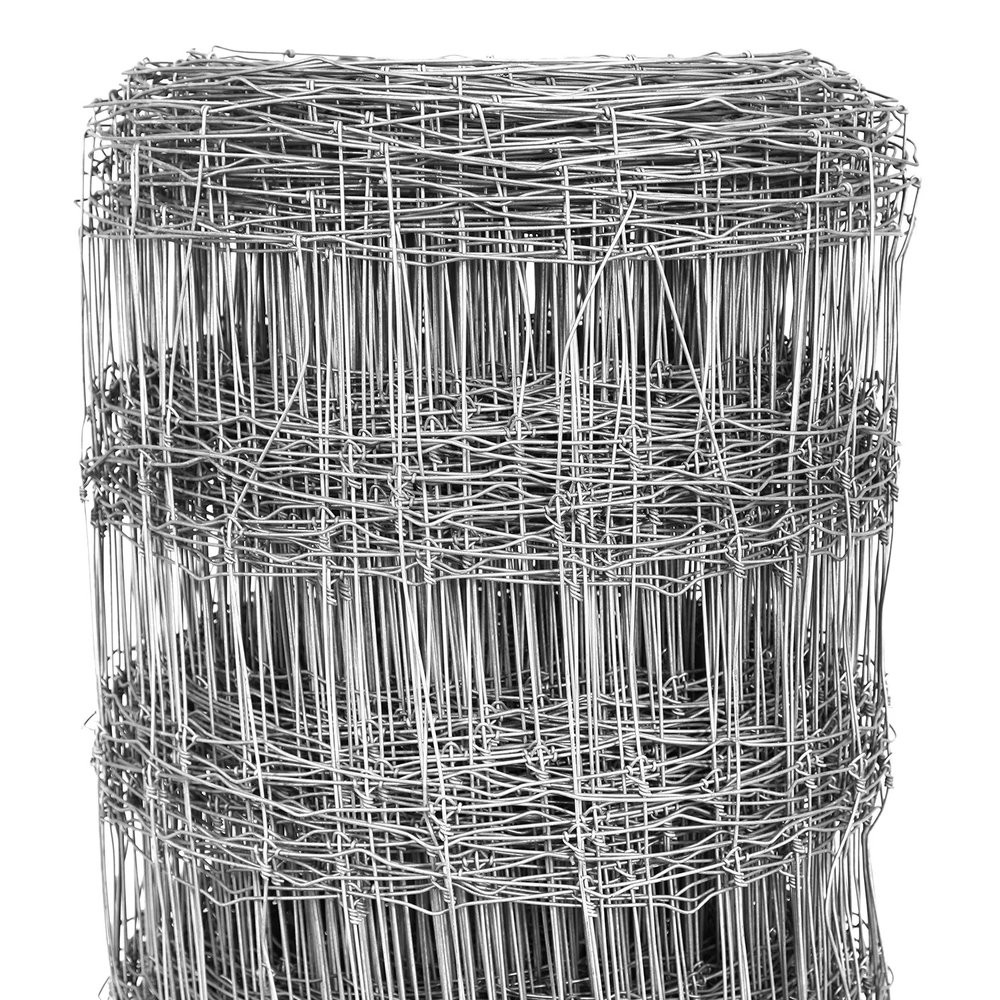
Hinge joint fence (also called field fence, farm fence or stock fence) is one of the most widely traded woven wire fencing products worldwide. Because the same product family covers many heights, wire counts and wire gauges, understanding the size system is the first step to getting an accurate quotation. If you are still comparing knot types, see our guide on fixed knot fence vs hinge joint fence.
1. How to Read Hinge Joint Fence Size Codes
Most suppliers and buyers describe hinge joint fence with a three-number code in the format line wires / height (cm) / stay spacing (cm):
- 8/90/15 — 8 horizontal line wires, 90 cm tall, vertical stay wires every 15 cm
- 9/115/15 — 9 line wires, 115 cm tall, stays every 15 cm
- 7/90/30 — 7 line wires, 90 cm tall, stays every 30 cm
- 13/190/15 — 13 line wires, 190 cm tall, stays every 15 cm (deer / exclusion height)
The US-style field fence numbering works differently: a 939 field fence means 9 line wires and 39 inches tall; 1047 means 10 line wires and 47 inches tall; 1348 means 13 line wires and 48 inches tall. The suffix (for example 939-6 or 1047-12) shows the vertical stay spacing in inches.
2. Common Hinge Joint Fence Sizes (Metric)
The table below lists the most frequently ordered metric hinge joint fence sizes and their typical applications. Custom combinations of height, wire count and stay spacing can be produced.
| Size Code | Height | Line Wires | Stay Spacing | Typical Application |
|---|---|---|---|---|
| 7/80/15 | 80 cm (32″) | 7 | 15 cm (6″) | Sheep, goats, small livestock |
| 8/90/15 | 90 cm (36″) | 8 | 15 cm (6″) | Sheep, goats, general farm boundary |
| 8/90/30 | 90 cm (36″) | 8 | 30 cm (12″) | Economy field fence, pasture |
| 8/100/15 | 100 cm (40″) | 8 | 15 cm (6″) | Mixed livestock, farm land |
| 9/115/15 | 115 cm (45″) | 9 | 15 cm (6″) | Cattle, mixed livestock |
| 10/120/15 | 120 cm (48″) | 10 | 15 cm (6″) | Cattle, horses (with sight wire), boundary |
| 11/140/15 | 140 cm (55″) | 11 | 15 cm (6″) | Tall boundary, mixed stock and wildlife pressure |
| 13/190/15 | 190 cm (75″) | 13 | 15 cm (6″) | Deer and wildlife exclusion |
KUNYU FENCING holds this range as stock hinge joint models in 330 ft rolls: 26 in (726-6-330) for sheep and small stock, 32 in (832-6-330) for sheep and goats, 39 in (939-6-330) and 47 in (1047-6-330) for general livestock and cattle, and 78 in (1478-6-330) for deer and wildlife pressure. Sizes outside the table are produced to drawing.
3. Common US-Style Field Fence Sizes
Buyers serving the North American market usually quote field fence with inch-based style numbers. These map closely to the metric hinge joint sizes above.
| Style Number | Line Wires | Height | Stay Spacing | Typical Roll Length |
|---|---|---|---|---|
| 726-6-330 | 7 | 26″ (66 cm) | 6″ (15 cm) | 330 ft (100 m) |
| 832-6 | 8 | 32″ (81 cm) | 6″ (15 cm) | 330 ft (100 m) |
| 939-6 / 939-12 | 9 | 39″ (99 cm) | 6″ or 12″ | 330 ft (100 m) |
| 1047-6 / 1047-12 | 10 | 47″ (119 cm) | 6″ or 12″ | 330 ft (100 m) |
| 1348-3 / 1348-6 | 13 | 48″ (122 cm) | 3″ or 6″ | 330 ft (100 m) |
How to read 1047/6: buyers may write the same specification as 1047/6, 1047-6, 1047 field fence or the complete 1047-6-330 hinge joint field fence. The first digits describe 10 line wires and 47 in height, 6 specifies vertical stay spacing, and 330 is the roll length in feet. Compare it directly with 939-6-330 livestock fence when selecting a lower farm-boundary option.
Note that in the US market, taller heavy-duty styles such as 949 and 2096 are usually produced as fixed knot fence rather than hinge joint. See the 49 in fixed knot pasture fence (949-6-330) and the 8 ft fixed knot deer fence (2096-6-330).
4. Wire Gauge and Tensile Strength Options
Two hinge joint fences with the same size code can perform very differently depending on wire gauge and steel grade. Always confirm these items in a quotation:
| Specification | Standard (Low Carbon) | High Tensile |
|---|---|---|
| Top / Bottom Wire | 2.5 mm (12.5 ga) typical | 2.5 mm (12.5 ga) high tensile |
| Inner Line Wires | 2.0 mm (14 ga) typical | 2.5 mm (12.5 ga) common |
| Tensile Strength | About 350–550 N/mm² | About 700–1235 N/mm² |
| Post Spacing | Closer posts needed | Allows wider post spacing |
| Best For | Economy farm fencing, price-sensitive markets | Cattle, long fence lines, lower lifetime cost |
Zinc coating also matters for service life. Options range from standard electro or hot-dip galvanizing to Class 3 zinc coating and zinc-aluminum coatings for coastal or high-humidity regions. Our high tensile hinge joint fence is produced with Class 3 galvanized wire as standard.
5. Roll Lengths and Packing
- 50 m rolls — easier manual handling, common for retail markets
- 100 m rolls — the most common export length; matches the US 330 ft standard
- 200 m rolls — for contractors and large pasture projects, machine handling
- Custom lengths — available to match local market habits
Rolls can be packed with simple ties, woven bag wrapping, cardboard-wrapped ends, pallets or custom private labels. Roll length and packing directly change how many rolls fit a container — see our container loading quantity guide for 20ft / 40ft estimates.
6. Which Hinge Joint Fence Size for Which Animal?
| Animal | Recommended Height | Suggested Sizes | Notes |
|---|---|---|---|
| Sheep / Goats | 80–100 cm (32–40″) | 7/80/15, 8/90/15, 8/100/15 | Use 15 cm stays; goats test fences more than sheep |
| Cattle | 100–120 cm (40–48″) | 9/115/15, 10/120/15, 1047-6 | High tensile preferred; barbed wire top strand common |
| Horses | 120–140 cm (48–55″) | 10/120/15 with top rail or sight wire | See our fence height guide |
| Pigs | 80–90 cm (32–36″) | 8/90/15 with heavy bottom wires | Consider barbed wire at ground level for rooting |
| Deer / Wildlife | 180–200 cm (72–80″) | 13/190/15 or fixed knot 2096-6 | Fixed knot recommended for heavy wildlife pressure |
7. RFQ Checklist: How to Ask for a Hinge Joint Fence Quotation
To get a fast, accurate price, include these items in your inquiry:
- Size code — e.g. 8/90/15 or style number 939-6
- Wire gauge — top/bottom and inner wire diameters
- Steel grade — standard low carbon or high tensile
- Zinc coating — standard galvanized, Class 3, or zinc-aluminum
- Roll length — 50 m, 100 m, 200 m or 330 ft
- Quantity — rolls, pallets or container quantity
- Packing — plain rolls, pallets, labels or private label
- Destination port — for FOB / CIF calculation
If you also need pricing background, read our hinge joint fencing price guide.
8. FAQ About Hinge Joint Fence Sizes
1. What do hinge joint fence size codes like 8/90/15 mean?
The first number is the count of horizontal line wires (8), the second is the fence height in centimeters (90 cm), and the third is the vertical stay spacing in centimeters (15 cm).
2. What sizes does hinge joint fencing come in?
Common heights are 80, 90, 100, 115, 120, 140 and 190 cm (about 32–75 inches), with roll lengths of 50 m, 100 m, 200 m or 330 ft, and stay spacing of 15 cm (6″) or 30 cm (12″).
3. What is the best size for sheep and goats?
An 80–100 cm fence with 15 cm stay spacing, such as 8/90/15, is the most common choice for sheep and goats.
4. What is the best size for cattle?
100–120 cm fence such as 9/115/15 or 10/120/15, ideally in high tensile wire, often with a barbed wire strand on top.
5. What wire gauge is used for hinge joint fence?
Typically 12.5 gauge (2.5 mm) top and bottom wires with 14 gauge (2.0 mm) inner wires; high tensile versions often use 12.5 gauge throughout.
6. How long is a roll of hinge joint fence?
Standard export rolls are 50 m, 100 m or 200 m; the US market standard is 330 ft (about 100 m). Custom lengths are available.
Request a Hinge Joint Fence Quotation by Size
Send us your size code (e.g. 8/90/15 or 939-6), wire gauge, coating, roll length, quantity and destination port. KUNYU FENCING supplies hinge joint field fence in standard and custom sizes with mixed container loading for T posts, barbed wire and accessories.