Both posts are roll-formed or hot-rolled from steel and driven into the ground without concrete, which is why they dominate agricultural fencing. But they are not interchangeable. Choosing the wrong one either wastes money (over-specifying) or causes fence failure (under-specifying).
1. What Is a T Post?
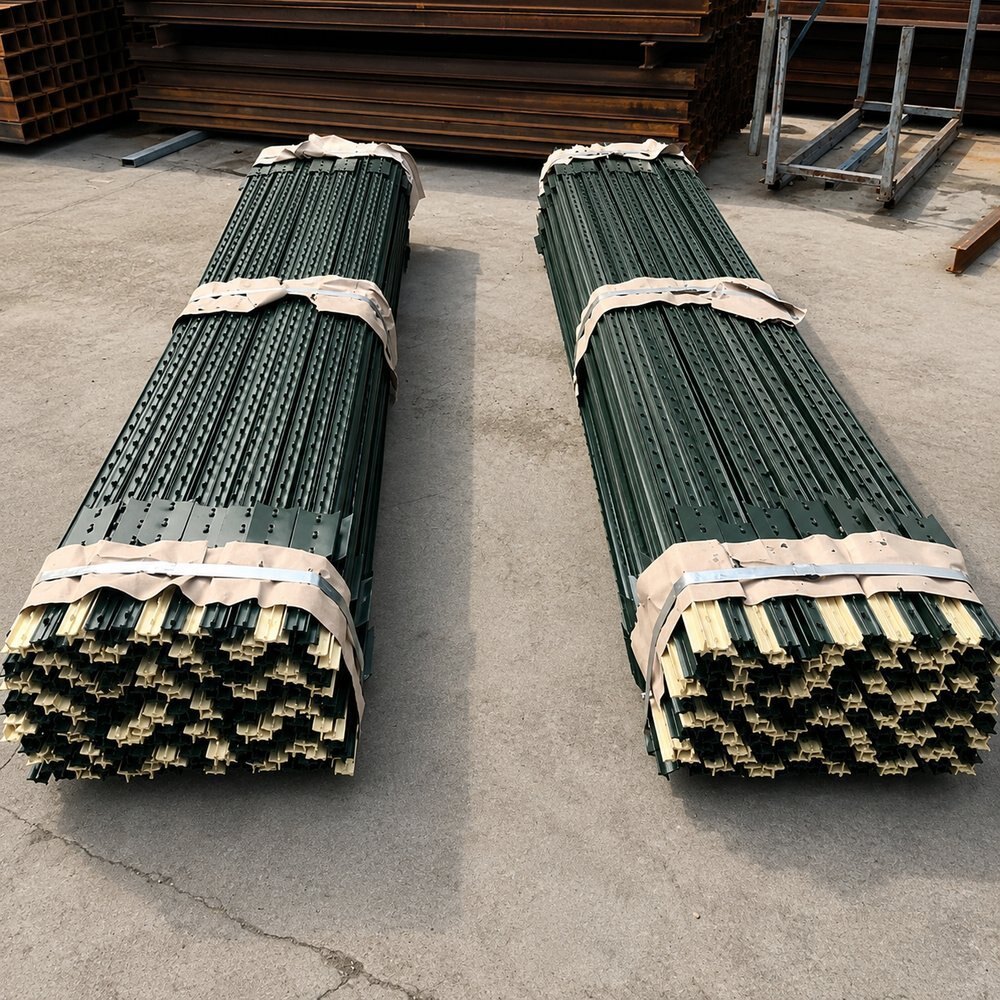
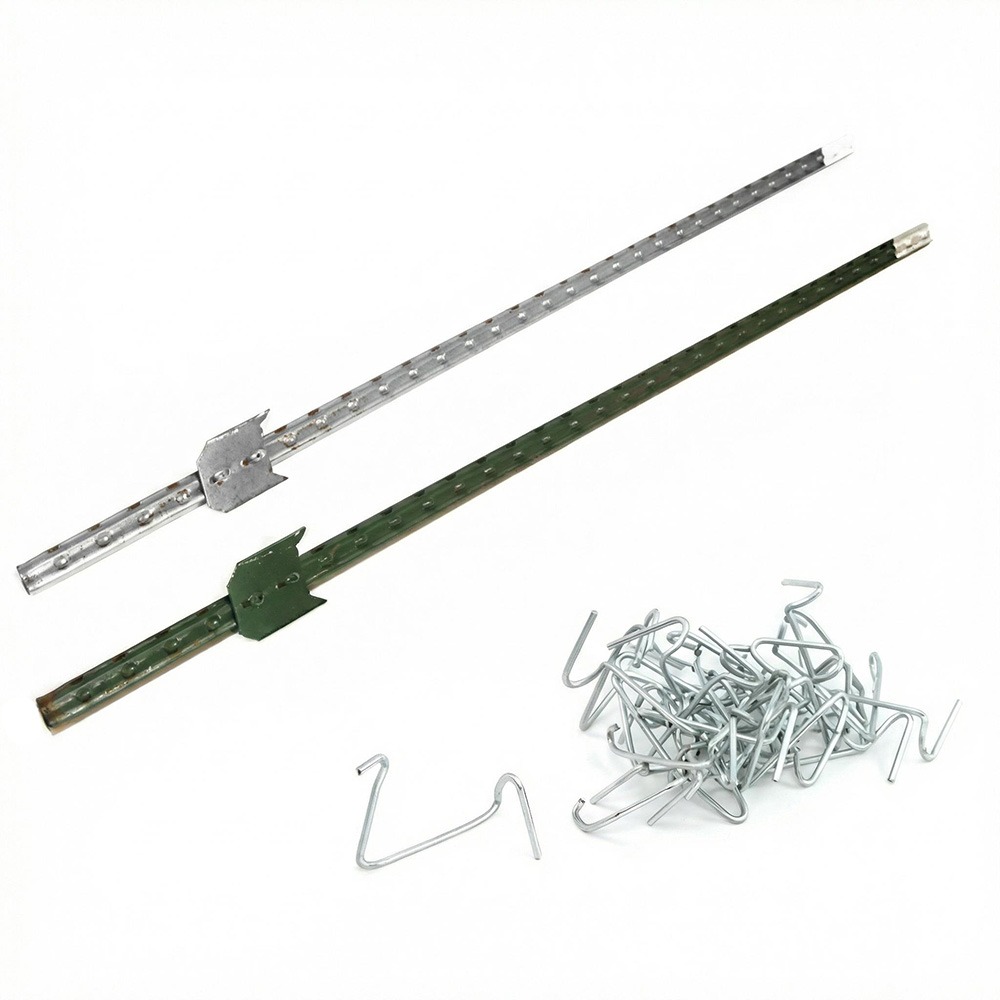
A T post (steel fence post, star picket in Australia/NZ) has a T-shaped cross section that resists bending in the fence-pull direction. Key features:
- Studs (nubs) along the face keep fence wires from sliding up or down
- Spade anchor plate near the bottom locks the post in the soil
- Common weights: 1.25 lb/ft and 1.33 lb/ft (heavy duty); lighter 0.95 lb/ft for economy markets
- Common lengths: 5 ft, 5.5 ft, 6 ft, 6.5 ft, 7 ft, 8 ft
- Finish: green painted with white top, full paint, or hot-dip galvanized
T posts pair with hinge joint field fence, fixed knot cattle fence and barbed wire, held on with wire clips. See our green steel T post product page for full specifications.
2. What Is a U Post?
A U post (U-channel post, light fence post) has a U-shaped cross section, usually with punched holes or hook tabs to attach light mesh. Key features:
- Lighter steel section — typically well under 1 lb/ft
- Punched holes / tabs for wiring on garden mesh or hanging signs
- Common lengths: 3 ft, 4 ft, 5 ft, 6 ft
- Small or no anchor plate — easy hand driving in soft soil
- Finish: painted (usually green) or galvanized
U posts suit garden borders, poultry and rabbit netting, tree guards, silt/erosion fence, temporary enclosures and sign posting.
3. U Post vs T Post: Side-by-Side Comparison
| Comparison Item | T Post | U Post |
|---|---|---|
| Profile | T-shaped section with studs | U-shaped channel with holes/tabs |
| Typical Weight | 0.95–1.33 lb/ft | Much lighter per foot |
| Bending Strength | High — resists livestock pressure | Low — bends under heavy load |
| Ground Anchor | Spade anchor plate | Small or none |
| Wire Attachment | Studs + wire clips | Holes / tabs + tie wire |
| Best Applications | Field fence, cattle, horse, sheep, barbed wire lines | Garden fence, poultry netting, temporary fence, signs |
| Typical Lengths | 5–8 ft | 3–6 ft |
| Price per Post | Higher (more steel) | Lower |
| Service Life Under Load | Long — permanent fencing | Short if used beyond light duty |
4. Which One Should You Choose?
| Project | Recommended Post | Why |
|---|---|---|
| Cattle / horse field fence | T post 1.25–1.33 lb/ft, 6–6.5 ft | Livestock pressure needs bending strength and anchor plate |
| Sheep / goat fence | T post 0.95–1.25 lb/ft, 5.5–6 ft | Moderate pressure; studs hold hinge joint mesh at height |
| Barbed wire line | T post | Studs keep strand spacing consistent over long runs |
| Vegetable garden / poultry netting | U post 4–5 ft | Light mesh, low pressure, lower cost |
| Temporary event / construction fence | U post | Cheap, light to transport, easy to pull and reuse |
| Signs and markers | U post | Punched holes accept bolts directly |
For post length and driving depth guidance, see how to choose the right T post. For how far apart to set posts on a fence line, see our T-post spacing guide for woven, welded and fixed-knot fence.
5. Buying U Posts and T Posts in Container Quantities
For importers and farm store chains, both posts are volume products with different sourcing details:
- Weight tolerance: specify lb/ft (or kg/m) and tolerance — "1.33 lb/ft nominal" should be confirmed with actual bundle weights
- Steel grade: rail steel or billet steel for T posts changes strength and price
- Paint / coating: green painted with white tip is the North American standard; galvanizing adds service life
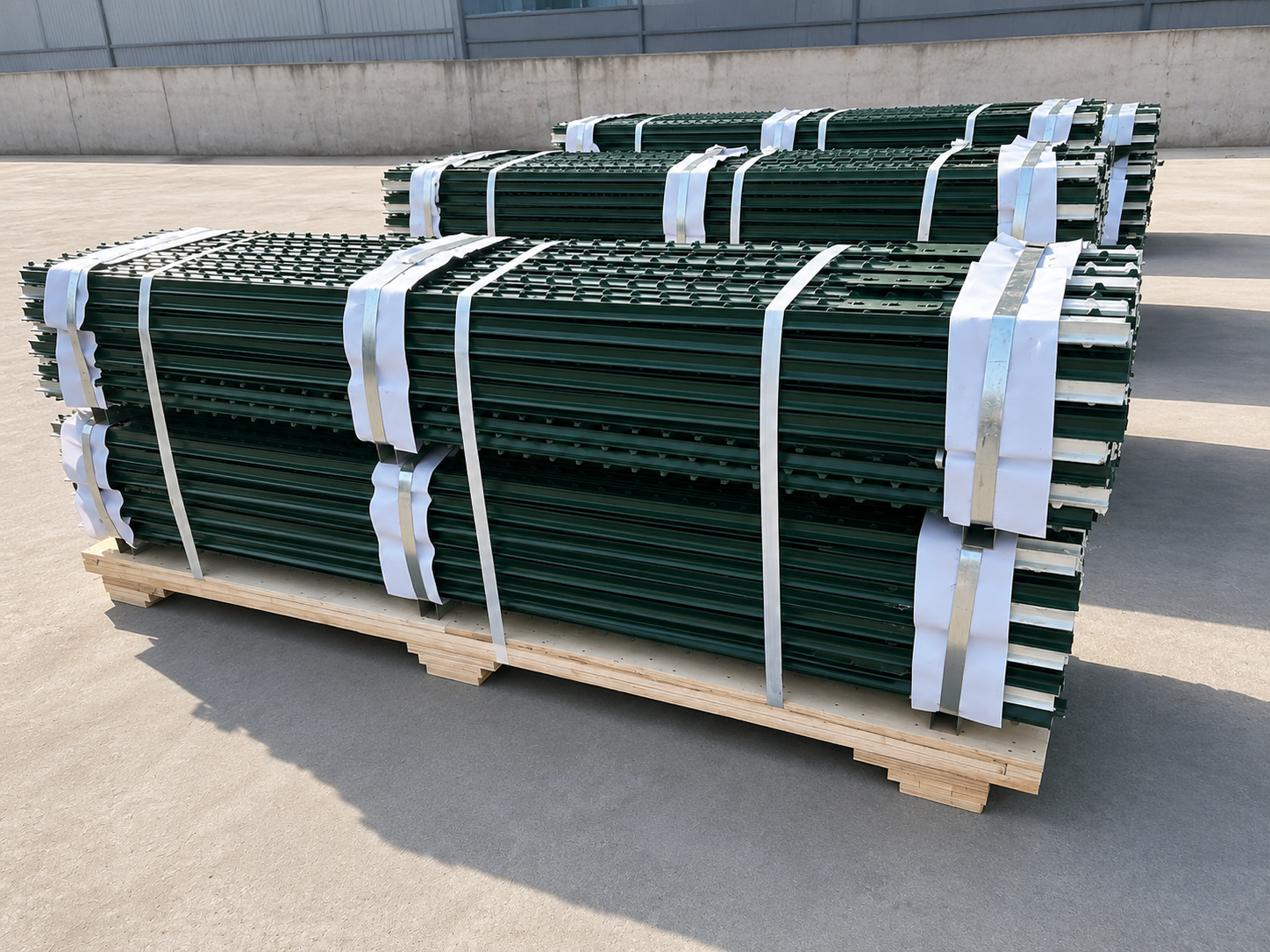
- Packing: bundles (usually 5 pieces per bundle for T posts) strapped on pallets; confirm pallet weight for forklift handling
- Mixed loading: posts load densely and combine well with fence rolls in one container — see the container loading guide
6. FAQ About U Posts and T Posts
1. What is the difference between a U post and a T post?
The steel profile. T posts have a T-shaped section with studs and an anchor plate for livestock fencing; U posts have a lighter U-channel with punched holes for garden and light-duty fencing.
2. Which is stronger, U post or T post?
T posts are significantly stronger. Standard 1.25 or 1.33 lb/ft studded T posts resist bending under animal pressure; U posts do not.
3. When should I use a U post?
Garden borders, poultry and rabbit netting, tree guards, silt fence, temporary fencing and sign posts — anywhere the load is light and budget matters.
4. Are U posts cheaper than T posts?
Yes, per post. But for livestock fencing, T posts are more economical overall because U posts fail under animal pressure and need replacement.
5. Can I use U posts for field fence?
Only for light garden or temporary field fence. Permanent livestock fence lines should use studded T posts (with wood posts at corners and gates).
Request a T Post / U Post Quotation
Send your post type, weight per foot, length, finish (painted or galvanized), quantity and destination port. KUNYU FENCING supplies steel T posts and fence accessories with pallet packing and mixed container loading with field fence rolls and barbed wire.