Post spacing is the biggest lever on fence installation cost after the wire itself: every extra foot of spacing removes dozens of posts per run. But spacing that is too wide for the mesh grade causes sagging fence and escaped livestock. The right spacing depends on three things — the mesh construction (woven, welded or fixed knot), the animal pressure, and the terrain. The sections below take each in turn.
1. Woven Wire vs Welded Wire: Why the Spacing Differs
Both are wire mesh, but they behave differently on the fence line, which is exactly why their T post spacing is not the same:
- Woven wire fence (field fence, hinge joint, fixed knot) is wrapped or knotted at each intersection. It flexes, can be stretched tight, and springs back after an animal hits it — so it tolerates wider post spacing.
- Welded wire fence is resistance-welded at each joint. It is flat and rigid, but the welds are brittle under impact and the panel cannot be re-tensioned once hung — so it needs closer posts to stay supported and straight.
In short: woven wire carries load along the wire, welded wire carries load at the posts. For the full construction comparison, see barbed wire vs woven wire fence.
2. T Post Spacing for Woven Wire Fence
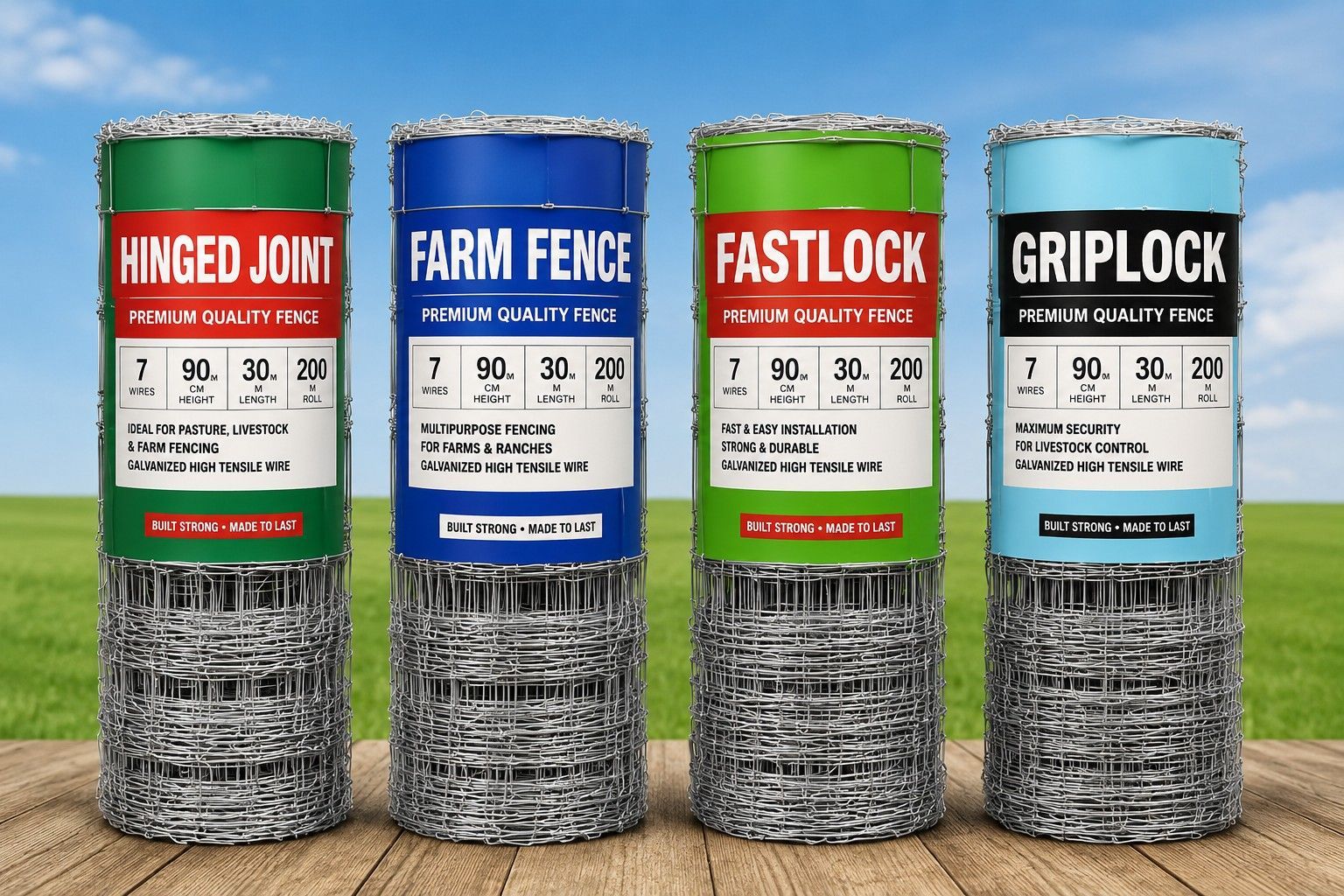
Woven wire fence — including field fence and hinge joint fence — is the most common farm mesh. Recommended T post spacing for woven wire fence is 8–12 ft, adjusted by wire grade:
| Woven Wire Type | Recommended T Post Spacing | Notes |
|---|---|---|
| Standard field / hinge joint (low carbon) | 8–10 ft (2.5–3 m) | Softer wire needs more support to avoid sag |
| High tensile hinge joint | 10–12 ft (3–3.5 m) | Stronger wire carries load between posts |
| Sheep & goat woven (small mesh) | 8–10 ft (2.5–3 m) | Closer posts keep the tight mesh taut |
Use 8 ft for cattle and heavy pressure, 10 ft as the general default, and 12 ft for low-pressure boundaries on flat ground. The tables below also express these spacing choices as posts per roll, per mile and per kilometer.
3. T Post Spacing for Welded Wire Fence
Welded wire fence is rigid but unforgiving — it will not re-tension and its welds crack under repeated flexing. It therefore needs closer T post spacing of 6–8 ft (1.8–2.5 m):
| Welded Wire Application | Recommended T Post Spacing | Notes |
|---|---|---|
| Garden / light welded fence roll | 8 ft (2.5 m) | Light mesh, low pressure, straight runs |
| Livestock / poultry welded fence | 6–8 ft (1.8–2.5 m) | Closer support where animals lean on the mesh |
| Tall welded panel (rigid) | Panel width (typ. 6.5–8 ft) | Set one post per panel joint; use clamp brackets |
Rule of thumb: welded wire fence uses roughly one post spacing tighter than woven wire of the same height. See our galvanized welded wire fence roll for standard sizes.
4. High Tensile Fixed Knot Fence: The Widest Spacing
Fixed knot fence is woven wire built with a separate rigid knot at every intersection and high tensile (700 N/mm² and above) wire. This combination gives the widest high tensile fence post spacing of any mesh:
| High Tensile Fence Type | Recommended Post Spacing | Notes |
|---|---|---|
| Fixed knot woven fence (flat ground) | 15–20 ft (4.5–6 m) | Rigid knots + high tensile wire carry the load |
| Fixed knot woven fence (rolling ground) | 12–15 ft (3.5–4.5 m) | Add posts at each dip and rise |
| High tensile smooth / barbed wire | 12–16.5 ft (3.5–5 m) | One rod (16.5 ft) is the classic standard |
Moving from 10 ft to 16.5 ft spacing removes about 200 posts per mile — post cost, freight and driving labor all drop together. That is why fixed knot fence usually wins on installed cost. Compare wire grades in fixed knot vs hinge joint fence, or view the high tensile fixed knot cattle fence designed for wide spacing.
5. Cattle, Deer and Horse Fence: Spacing Differences by Animal
The animal changes both the spacing and the fence type. These are the field-tested numbers:
| Animal / Use | Typical Fence | T Post Spacing | Why |
|---|---|---|---|
| Cattle | Fixed knot or hinge joint woven | 8–10 ft | Cattle lean and push; tighten to 8 ft at corrals and feed areas |
| Deer / wildlife | 7.5–8 ft tall fixed knot | 15–20 ft | Tall high tensile fence relies on wire tension, not post count |
| Horse | Non-climb woven / V-mesh | 8–10 ft | Closer spacing keeps mesh taut and safe; improves appearance |
| Sheep & goat | Small-mesh woven | 8–10 ft | Goats climb; closer posts resist pressure at the mesh |
| Garden / poultry | Welded wire | 6–8 ft | Light rigid mesh needs closer support |
So cattle fence T post spacing stays tight at 8–10 ft, while deer fence post spacing is the widest at 15–20 ft because the fence is tall high tensile fixed knot. For heights by livestock type, read the cattle fence height guide.
6. Corner, Brace and Line Posts: Different Jobs
A fence has three post roles, and only one of them is a T post. Mixing them up is the most common cause of a fence that later sags or leans:
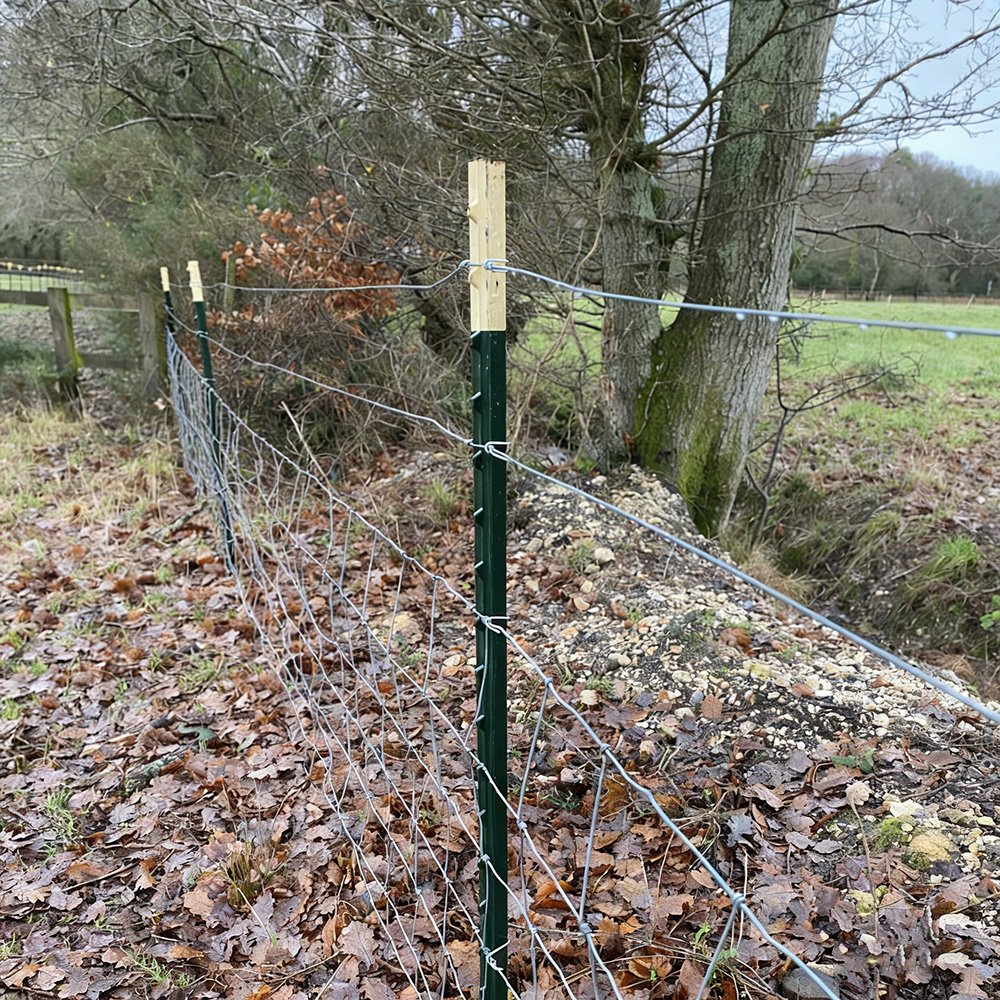
- Line posts (T posts): hold the fence upright between the corners. They carry no stretching tension — only the mesh. This is the spacing everything above refers to.
- Corner & end posts: carry the full stretching tension of the run (several hundred kg with high tensile wire). Use treated wood 4–6″ in diameter or steel pipe, set 3–4 ft deep. Never a T post.
- Brace posts: an H-brace or diagonal brace within about 8 ft of each corner and end post, tying the corner back so it cannot pull inward.
- Gate posts: sized for the gate weight and always braced.
On long straight runs, add a braced line assembly roughly every 1/4 mile (400 m) so the fence can be re-tensioned. See how the posts work together in how to install field fence.
7. T Post Length by Fence Height
Pick the post length after you know the fence height. The rule: add about 2 ft (0.6 m) to the fence height for the portion driven below ground (to the anchor plate). Firm soil allows the minimum burial; sandy or wet soil needs deeper setting and a longer post.
| Fence Height | Recommended T Post Length | Typical Use |
|---|---|---|
| 32–36 in (0.8–0.9 m) | 5 ft (1.5 m) | Garden, poultry, low welded fence |
| 4 ft (1.2 m) | 6 ft (1.8 m) | Sheep, goat, general field fence |
| 5 ft (1.5 m) | 6.5–7 ft (2–2.1 m) | Cattle and horse fence |
| 6 ft (1.8 m) | 8 ft (2.4 m) | Tall livestock / boundary fence |
| 7.5–8 ft (2.3–2.4 m) | 10 ft (3 m) | Deer and wildlife exclusion fence |
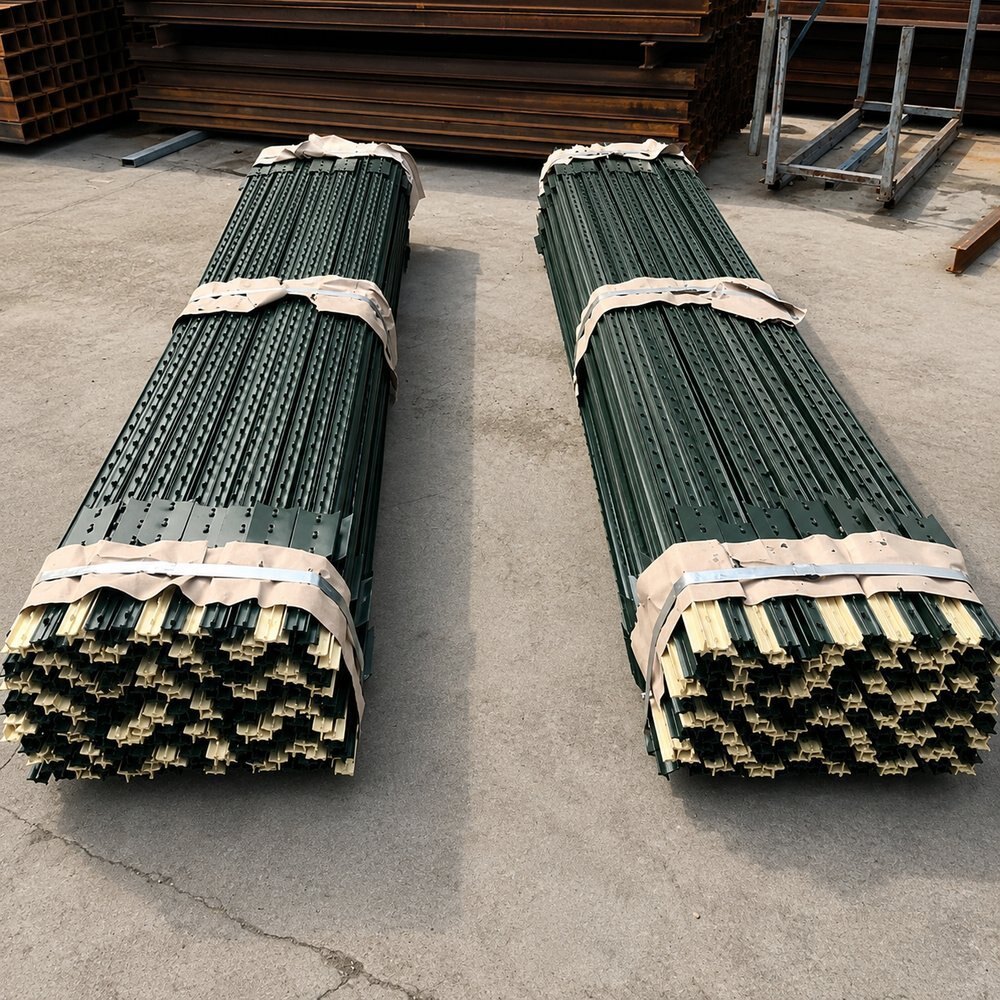
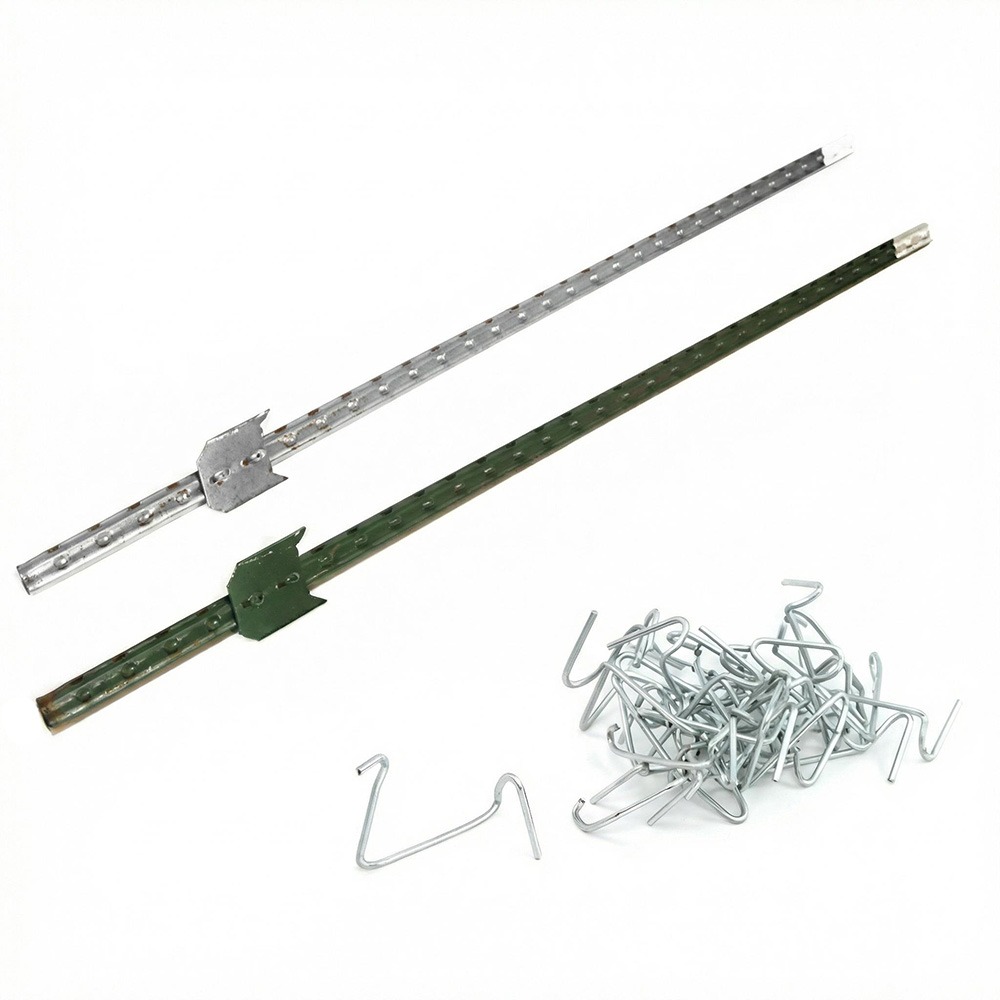
For weight, coating and studded-profile selection, see how to choose the right T post, or view the 6 ft green steel T post and steel fence T post range. Deciding between profiles? Read U post vs T post.
8. T Post Quantity Formula
For one straight fence run, round the number of spaces up to keep the maximum spacing within your plan. Count structural end, corner and gate posts separately from line T posts.
Spaces = round up (run length ÷ maximum post spacing)
Total support positions, including both ends = spaces + 1
Interior line T posts, when both ends are structural posts = spaces − 1
The table counts all support positions, including two endpoints, for one straight run. It is not a T-post-only order quantity. These examples exclude extra braces, gates, terrain adjustments and spare stock.
| Maximum spacing | 330 ft run (100.6 m) | 1,000 ft run (304.8 m) | 1 mile run (5,280 ft) |
|---|---|---|---|
| 6 ft | 56 | 168 | 881 |
| 8 ft | 43 | 126 | 661 |
| 10 ft | 34 | 101 | 529 |
| 12 ft | 29 | 85 | 441 |
| 16.5 ft | 21 | 62 | 321 |
| 20 ft | 18 | 51 | 265 |
For multiple runs, calculate each run separately and count shared corners only once. A closed boundary does not use the straight-run “+1” rule for its full perimeter. Review dips, rises, curves, gates and bracing before placing the order.
9. Project Purchasing Examples
These are geometry and quantity examples, not installation specifications. Confirm spacing, post length and bracing for the selected fence, livestock, soil and terrain. Whole-roll quantities are rounded up; allow separately for joins, waste and repairs.
Example A — square 10-acre boundary, before gates
- Perimeter: four 660 ft sides = 2,640 ft.
- At a planned maximum 12 ft spacing: 55 spaces per side; 54 interior line positions per side = 216 line positions, plus four corner positions.
- Final T-post quantity: adjust those line positions for the gate opening, brace assemblies and any additional supports; do not count a structural post twice.
- Rolls: 2,640 ÷ 330 = 8 rolls for net perimeter alone. Eight rolls leave no allowance for joins or waste.
Example B — one straight 1,000 ft deer-fence run
- At a planned maximum 16.5 ft spacing: round up (1,000 ÷ 16.5) = 61 spaces.
- Supports: 62 total positions, including two structural endpoints; 60 interior line positions before adding any intermediate bracing.
- Whole rolls: round up (1,000 ÷ 330) = 4 rolls. Three rolls cover only 990 ft.
Example C — one straight 300 ft welded-wire run
- At a planned maximum 8 ft spacing: round up (300 ÷ 8) = 38 spaces.
- Supports: 39 total positions, including two structural endpoints; 37 interior line positions before additional bracing.
- Whole rolls: 300 ÷ 100 = 3 rolls for net length alone, if using 100 ft rolls. Add any required join and waste allowance.
For a wholesale order, compare our steel T post sizes and weight grades, field fence models and container loading guide.
Request a fence and post quotation — send the run lengths, fence height, destination country and any planned gates. We can review the purchasing specification before quoting.
10. FAQ About Woven and Welded Wire Fence Post Spacing
1. What is the T post spacing for woven wire fence?
8–12 ft (2.5–3.5 m): 8 ft for cattle pressure, 10 ft as the default, 12 ft for low-pressure boundaries. High tensile fixed knot woven fence allows 15–20 ft.
2. What is the T post spacing for welded wire fence?
6–8 ft (1.8–2.5 m). Welded mesh cannot be re-tensioned and its welds are brittle, so it needs closer support than woven wire — about one spacing tighter for the same height.
3. What is the correct high tensile fence post spacing?
15–20 ft for fixed knot woven fence on flat ground, or 12–16.5 ft for high tensile smooth and barbed wire. The wire holds tension and springs back, so it carries load between posts.
4. What is the T post spacing for cattle and deer fence?
Cattle fence T post spacing is 8–10 ft because cattle lean on the fence. Deer fence post spacing is 15–20 ft because tall fixed knot fence relies on wire tension rather than post count.
5. What length T post do I need?
Add about 2 ft to the fence height for burial: a 4 ft fence uses a 6 ft post, a 5 ft fence a 6.5–7 ft post, and an 8 ft deer fence a 10 ft post.
6. How do I calculate T post quantity?
For a straight run, round up (run length ÷ maximum spacing) to obtain the spaces. Total support positions = spaces + 1, including both ends. If both endpoints are structural posts, interior line T posts = spaces − 1. At 1,000 ft and 10 ft spacing, that means 101 total positions, including 99 interior line positions. Count bracing and gates separately; calculate closed boundaries run by run.
Related T Post Planning Guides
- How to install field fence — corner bracing, stretching, clipping and line-post setup.
- U post vs T post — compare strength, weight, cost and applications.
- Bulk T post buying guide — sizes, finishes, MOQ and container loading.
- Steel T Post Manufacturer & Wholesale Range — review 5–10 ft models for wholesale orders.
Source Woven Fence, Welded Fence and T Posts Together
KUNYU FENCING supplies woven field fence, fixed knot fence, welded wire fence, steel T posts and clips with mixed container loading — matched in the right roll-to-post ratios for your market and spacing. Send your fence height, spacing and destination port for a complete FOB / CIF quotation with a full bill of materials.