
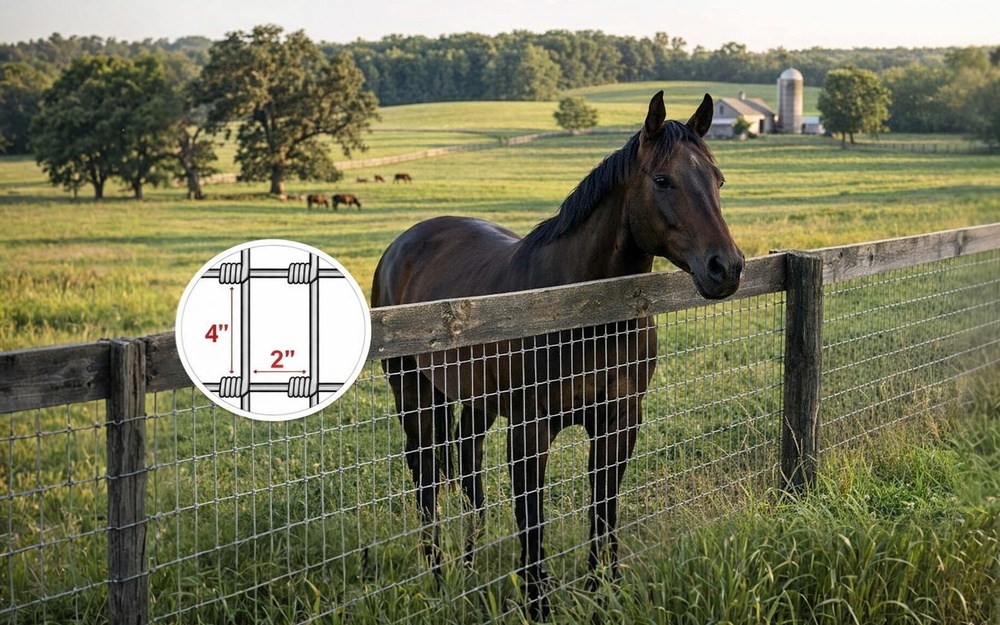
For a permanent horse pasture, compare close-mesh woven horse fence with visible rail systems. Choose height and openings for the animals first, then price the complete installed system. For temporary grazing divisions inside a secure perimeter, a visible electric tape or rope system can reduce material needs, but requires power, training and frequent checks.
How do I choose the right height and spacing for a horse fence?
University of Minnesota Extension recommends a perimeter about 5 ft high and dividing fences about 4.5–5 ft high. Treat these as planning guidance, then assess the size, age and behavior of your horses and the site with your installer. Taller animals or horses that challenge fences need a separate design review. A taller roll alone does not make a safe enclosure.
| Decision | What to specify | What to avoid |
|---|---|---|
| Finished height | Measure from the installed ground level; include low points, gates and changes of grade. | Using nominal roll height without checking the ground gap. |
| Mesh openings | Specify both opening dimensions. KUNYU lists horse models with 2 in stay spacing and approximately 2 × 4 in openings. Review foals, miniature horses and shoes separately. | Treating small mesh as a guarantee that entrapment is impossible. |
| Rails and ground clearance | Review every clear gap, including the bottom, gate and transitions. Rail spacing and mesh spacing are different measurements. | Applying a rail-spacing rule to a mesh product. |
| Post spacing | Use the selected system’s installation design, soil, bracing and terrain. Distinguish line posts from end, corner and gate assemblies. | Choosing a universal post distance from the knot name. |
| Contact and visibility | Check cut ends, clips, fasteners and gate hardware; provide a clearly visible boundary. | Barbed wire in horse-contact areas or barely visible strands. |
Read the University of Minnesota horse-fencing guidance for containment, visibility and maintenance considerations. No fence can eliminate every injury or escape risk.
What are affordable options for horse fencing?
Compare a suitable woven no-climb perimeter with a rail system, and use managed electric divisions where appropriate. The affordable choice depends on how much physical containment, visibility and daily maintenance the property needs. Request prices for the same usable fence length, height, gates and supporting structure.
| Option | Where to compare it | Budget items often omitted |
|---|---|---|
| Woven no-climb horse mesh | Permanent paddocks and pastures with appropriate openings and visible boundaries. | Braces, safe post fittings, top visibility rail, gates, tensioning and labor. |
| Wood or vinyl rail | Visible boundaries, entrances and horse paddocks with a suitable structural design. | Posts, rail connections, replacements and any secondary barrier needed for smaller animals. |
| Electric tape or rope | Managed internal divisions; see temporary-fencing conditions below. | Energizer, grounding, compatible insulators, reels, testing and vegetation control. |
| Light welded utility mesh | Evaluate for its stated utility application. Do not substitute it solely because its openings match horse mesh. | Weld performance under repeated animal contact; repair and replacement risk. |
UGA’s Fences for Horses cautions that inexpensive welded 2 × 4 in mesh may fail at the welds in field use. A welded utility roll and woven horse fence are different constructions.
Example: estimating roll quantities
For a 1,000 ft net fence run and 200 ft rolls, the geometric minimum is 1,000 ÷ 200 = 5 rolls. That excludes cut lengths, joints and waste. Calculate each run between termination assemblies, then confirm the purchase quantity. Gates and braces need their own schedule. Compare the resulting material list, installation and maintenance costs rather than price per roll alone.
What materials suit temporary horse fencing?
Consider visible electric polytape or horse-appropriate conductive rope, compatible insulated posts, reels, connectors and a correctly selected energizer and grounding system. Tape visibility, wind exposure and handling needs should guide the choice. Follow the complete system supplier’s spacing, tension and electrical instructions.
The University of Kentucky recommends temporary electric fencing for subdivisions within an existing perimeter. Its main effect is behavioral deterrence. Introduce trained horses under supervision, test voltage, manage vegetation and plan for power failure. Temporary fencing is not a substitute for a suitable external boundary.
Electric systems are discussed for selection purposes. KUNYU’s listed horse range on this site is woven wire, vinyl rail and posts; ask a specialist for a compatible complete electric system.
Choose a listed model, then approve the order specification
| KUNYU listed option | Reference geometry | Next step |
|---|---|---|
| 1660-2-200 S-knot horse fence | 16 line wires; 60 in height; 2 in stay spacing; 200 ft length. | Review the 60 in model |
| 1972-2-200 S-knot horse fence | 19 line wires; 72 in height; 2 in stay spacing; 200 ft length. | Review the 72 in model |
| 3-rail vinyl system | Specify the full section, post profiles, rail connections and installation. | Review vinyl specifications |
These references identify products, not approval for a particular horse or enclosure. Send the animal group, site layout, net fence runs, gate plan, chosen model, complete openings, wire diameters, coating requirement, quantity, packing and destination. Confirm measured roll weight, package dimensions and inspection scope in the quotation. KUNYU reviews bulk export orders; small urgent purchases may be better served by a local agricultural dealer.
Compare Horse Fencing Supplies Request a bulk quotation
For mixed livestock or cattle paddocks, start with the farm and paddock selection guide.