Sheep and goat fence is the hardest woven wire product to specify, because the two animals it is named after break fences in opposite ways. Sheep push along a fence line and lean on it. Goats climb it, stand on it, and reach through it. A specification that satisfies one can fail the other, and the difference between a fence that works and one that gets returned is usually a single number in the model code.
1. Why Sheep and Goat Fence Fails
Cattle fence is designed against weight. A 600 kg cow leaning on a wire is a load problem, answered with high tensile wire and a knot that does not slip. Small stock is a geometry problem instead.
- Escape through the mesh. A lamb or a kid goes through an opening a cow would not notice. Once one animal learns the route, the flock follows.
- Horned stock getting stuck. A horned goat pushes its head through a 6 in opening to reach feed on the other side, then cannot pull the horns back. This is the expensive failure: injury, predation, and dead stock, not just a repair.
- Climbing. Goats use horizontal wires as steps. Wide stay spacing gives them a bigger foothold.
All three are answered by the same variable — how far apart the vertical stay wires sit — which is why the stay spacing, not the height, is the first thing to fix in an enquiry.
2. Stay Spacing: 6 in, 4 in or 2 in
Vertical stay spacing is the last number before the roll length in a model code. In 1348-4-330, the 4 is a 4 in stay spacing.
| Stay Spacing | Mesh Opening | Suits | Risk |
|---|---|---|---|
| 6 in | 6 × 6 in and wider at the top | Sheep only, cattle, general farm boundary | A horned goat can pass its head through and stick |
| 4 in | 4 × 4 in | Sheep, polled goats, mixed small stock | Determined horned goats can still reach through |
| 2 in | 2 × 4 in | Horned goats, kids, predator pressure, non-climb | Heaviest and most expensive per foot |
The practical rule buyers give their customers: if the herd is polled or disbudded, a 4 in stay is enough. If there are horns, quote the 2 in stay and explain why. A 2 in mesh costs more per foot, but one stuck goat costs more than the difference across a whole paddock.
Standard field fence at 6 in stay spacing is frequently sold into sheep and goat use because it is cheaper. It works for sheep. It is the wrong product for horned goats, and it is worth saying so at the quotation stage rather than after the container lands.
3. Height: What It Actually Buys
Height does not stop a head going through the mesh. It stops jumping, climbing over, and predators coming in. Once the mesh is right, choose height from the pressure on the line:
| Height | Line Wires | Typical Use |
|---|---|---|
| 32 in (81 cm) | 8 | Sheep, lambing paddocks, internal divisions with no climbing pressure |
| 48 in (122 cm) | 13 | General sheep and goat boundary — the volume size |
| 60 in (152 cm) | 16 | Active goats, boundary lines, coyote and dog pressure |
| 72 in (183 cm) | 19 | Perimeter exclusion, high predator load, stock that has already learned to climb |
A common mistake in enquiries is going tall to solve a mesh problem. A 72 in fence at 6 in stay spacing still passes a goat's head at 12 in off the ground; a 48 in fence at 2 in stay does not. Fix the mesh, then buy the height the site needs.
4. The Four Standard S Knot Models
These are the S knot models KUNYU FENCING runs as stock specifications for small stock. Every one is high tensile wire, galvanized, with the S knot wrapped separately at each intersection.
| Model | Height | Line Wires | Stay Spacing | Roll Length | Best For |
|---|---|---|---|---|---|
| 1348-4-330 | 48 in / 4 ft | 13 | 4 in | 330 ft | Sheep and polled goats — the volume seller |
| 1660-4-330 | 60 in / 5 ft | 16 | 4 in | 330 ft | Same mesh, more height against climbing and predators |
| 1660-2-200 | 60 in / 5 ft | 16 | 2 in | 200 ft | Horned goats, kids, non-climb applications |
| 1972-2-200 | 72 in / 6 ft | 19 | 2 in | 200 ft | Perimeter exclusion at the tightest mesh |
The 2 in models are catalogued as non-climb horse fence, because a 2 × 4 in opening is the same specification a horse paddock needs to stop a hoof passing through. It is one product serving two markets — useful for distributors who want a single SKU covering horse and horned goat customers.
5. S Knot, Hinge Joint or Fixed Knot for Small Stock
The knot is what holds the stay to the line wire, and it decides what happens when an animal leans on the mesh.
| Knot | Behaviour Under Load | For Sheep and Goats |
|---|---|---|
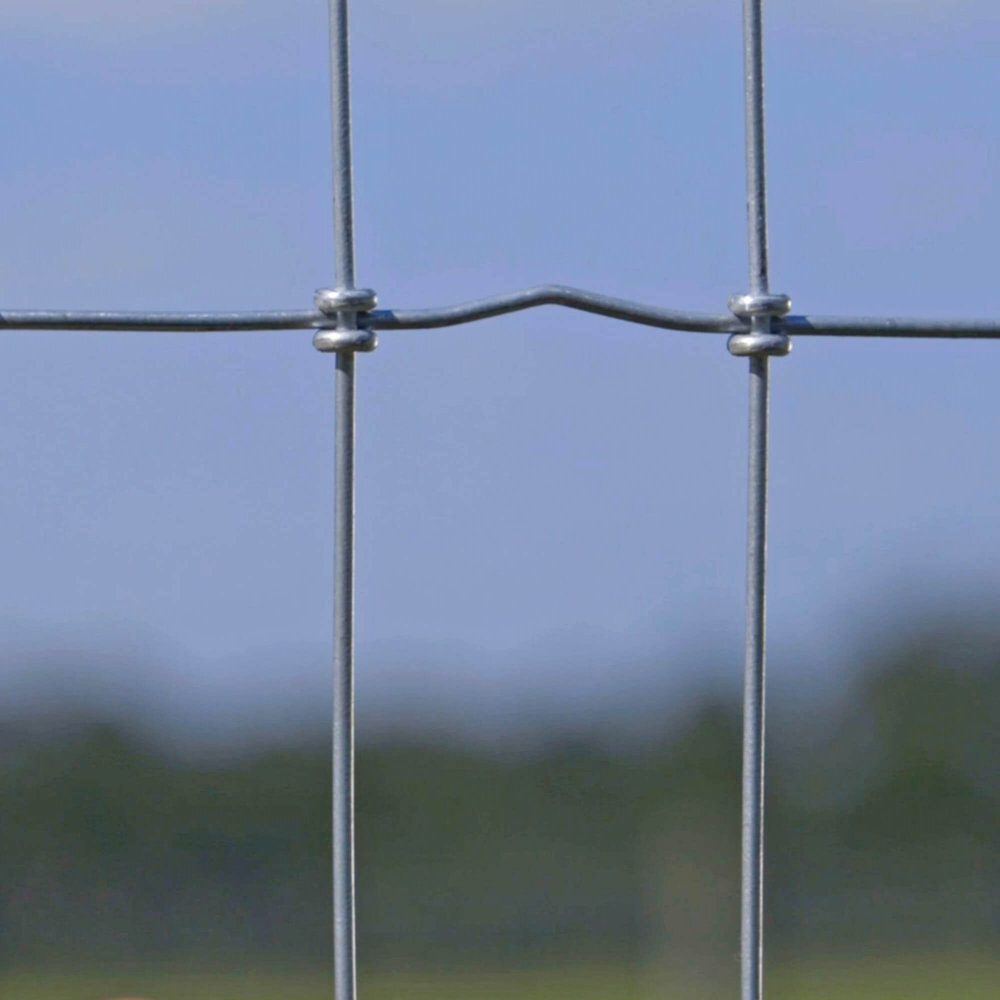
| S knot | A separate wrap at each intersection; holds the opening but gives slightly | The usual choice — keeps mesh geometry without the price of fixed knot |
| Hinge joint | The stay wraps the line wire and hinges under pressure, then springs back | Economical, but the opening deforms — a goat that leans can widen it |
| Fixed knot | A separate wire locks the joint; the opening does not move | Strongest and most rigid, usually specified for cattle and deer heights |
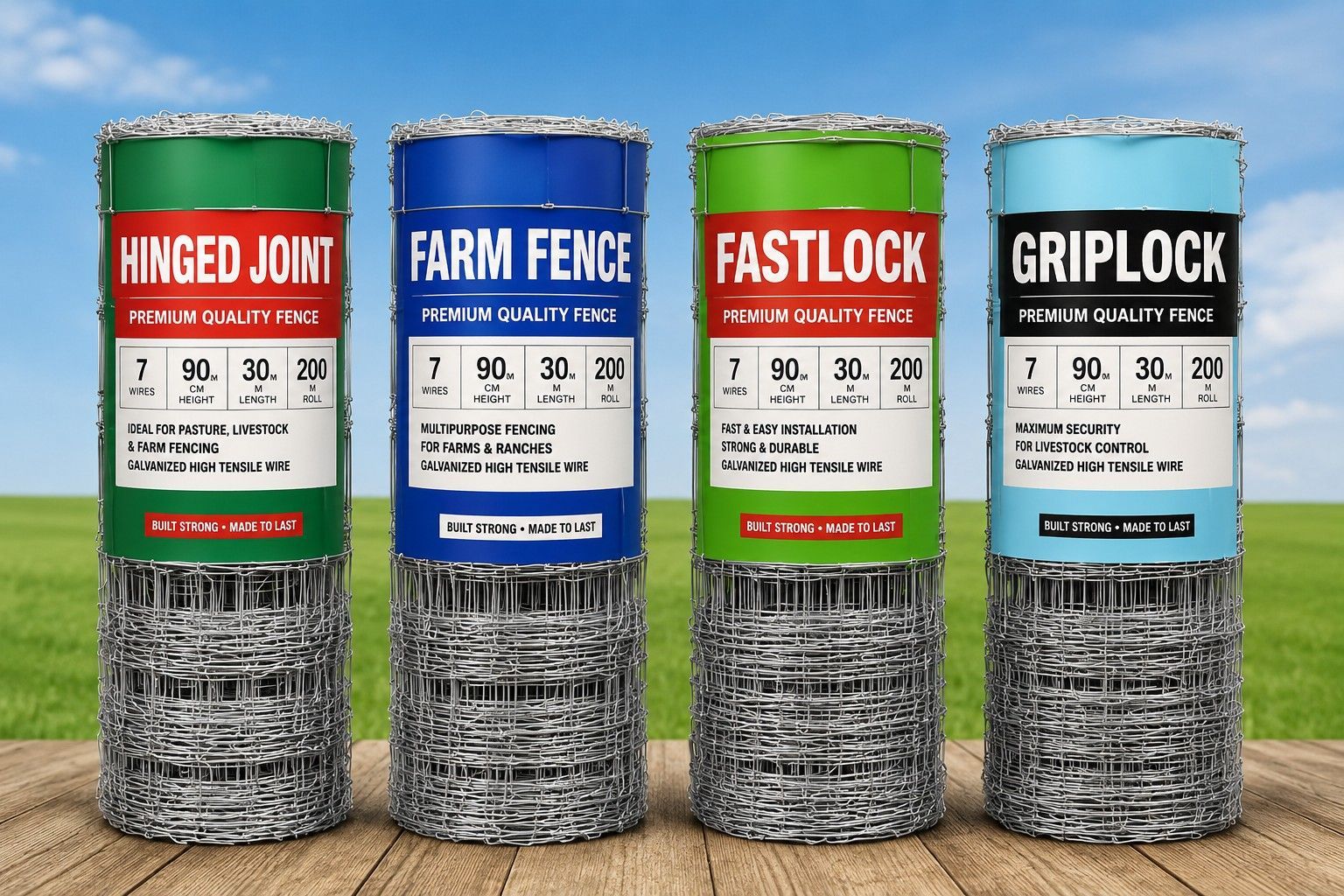
For a price-led market the 32 in hinge joint sheep and goat fence (832-6-330) remains the entry product, and it sells well where flocks are sheep-only. Where the herd includes goats, the S knot at 4 in or 2 in stay is the specification that stops call-backs. If the same buyer also needs hog or pen fencing, the 42 in fixed knot hog fence (842-6-330) covers the rooting problem the same way, with close bottom spacing. For the full knot comparison, see fixed knot vs hinge joint fence.
6. Roll Length and Container Economics
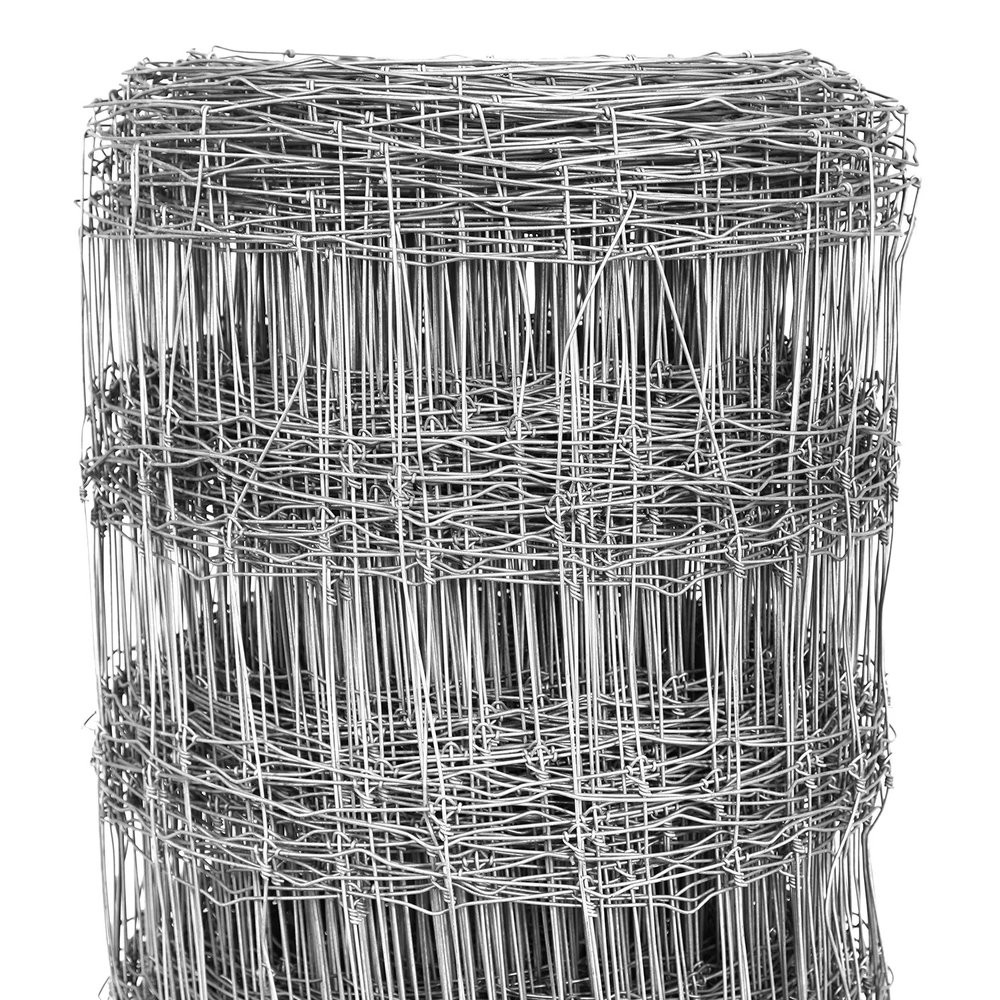
This is where the mesh decision reaches the landed cost, and it is the part most enquiries miss. Halving the stay spacing roughly doubles the number of vertical wires per foot of fence. The roll gets heavier, so it gets shorter.
- 4 in stay ships in 330 ft rolls
- 2 in stay ships in 200 ft rolls
Two consequences for a wholesale buyer. First, comparing a price per roll across the two specifications is meaningless — compare price per foot or per metre of fence line. Second, a 2 in stay container carries far fewer feet of fence than a 4 in stay container of the same weight, so freight per foot rises on top of the material cost. Work the quantity out before quoting your customer, not after. Our container loading guide gives the roll and weight figures for 20 ft and 40 ft loads.
7. Wire, Tensile Grade and Coating
Three specification lines behind the model code, each of which moves the price:
- Wire gauge. 12.5 gauge (2.5 mm) top and bottom wires are standard, often with lighter inner wires. Confirm both diameters — two quotes at the same model number can differ here.
- Tensile grade. High tensile holds the mesh shape under repeated pressure and allows wider post spacing. Low carbon is cheaper and more forgiving to install on uneven ground.
- Zinc coating. Standard galvanized suits dry inland use. Class 3 zinc or zinc-aluminium is worth the difference in coastal and high rainfall markets, where a thin coating is the reason a fence looks old in three years.
8. Post Spacing for Sheep and Goat Fence
Small stock fence is normally posted closer than cattle fence, for the same reason the mesh is tighter — the failure is local, not structural. High tensile S knot at 48 to 60 in will carry 10 to 12 ft post spacing on level ground, but goats concentrate pressure at gates, corners and anywhere feed sits on the other side. Tighten to 8 ft at those points and keep the bottom wire close to the ground, since kids go under before they go through. Full figures are in the T post spacing guide, and 6 ft steel T posts are the usual line post for 48 in mesh.
9. RFQ Checklist for Sheep and Goat Fence
An enquiry with these nine lines can be quoted the same day:
- Stock type — sheep only, polled goats, or horned goats
- Stay spacing — 6 in, 4 in or 2 in
- Height — 32, 48, 60 or 72 in
- Model or line wire count — for example 1348-4-330
- Wire gauge — top, bottom and inner wire diameters
- Tensile grade — high tensile or low carbon
- Coating — standard galvanized, Class 3 or zinc-aluminium
- Roll length and quantity — plus packing and labelling
- Destination port — for FOB or CIF
If posts, clips or barbed wire go in the same container, list them together so the loading plan is drawn once.
10. FAQ About Sheep and Goat Fence
1. What size mesh stops goats getting their heads stuck?
A 4 in vertical stay spacing (4 × 4 in opening) is the standard for sheep and polled goats. For horned goats use a 2 in stay spacing, which gives a 2 × 4 in opening that horns cannot pass through. A 6 in stay, the standard field fence spacing, will let a horned goat put its head through and trap it.
2. How tall should a goat fence be?
48 in is the volume size for general sheep and goat boundary. Go to 60 in for active goats, boundary lines and dog or coyote pressure, and 72 in for perimeter exclusion or stock that has already learned to climb. Height stops jumping and climbing; it does not stop a head passing through the mesh.
3. What does the model code 1348-4-330 mean?
13 horizontal line wires, 48 in fence height, 4 in vertical stay spacing and a 330 ft roll. The same system reads 1660-4-330 as 16 line wires at 60 in with 4 in stays in a 330 ft roll, and 1972-2-200 as 19 line wires at 72 in with 2 in stays in a 200 ft roll.
4. Why are 2 in stay rolls only 200 ft?
Halving the stay spacing roughly doubles the vertical wire per foot of fence, so the roll becomes heavier. A 200 ft roll at 2 in stay keeps the weight in the range a crew can handle and a container can stow. It also means price per roll cannot be compared across the two specifications — compare price per foot instead.
5. Is S knot or hinge joint better for sheep and goats?
S knot holds the mesh opening under pressure while hinge joint deforms and springs back, so a goat that leans on hinge joint fence can widen the opening over time. Hinge joint is the economical choice for sheep-only flocks; S knot is the specification that avoids call-backs where goats are in the herd.
6. Can sheep and goat fence be loaded with T posts and barbed wire?
Yes. Fence rolls, steel T posts, barbed wire coils, clips and accessories load together in one 20 ft or 40 ft container. The loading plan depends on roll dimensions, weights and packing method, and is confirmed before production.
Request a Sheep and Goat Fence Quotation
Send the stock type, stay spacing, height, wire gauge, coating, roll length, quantity and destination port. KUNYU FENCING manufactures S knot, hinge joint and fixed knot woven wire fence, with mixed container loading for T posts, barbed wire and accessories.