
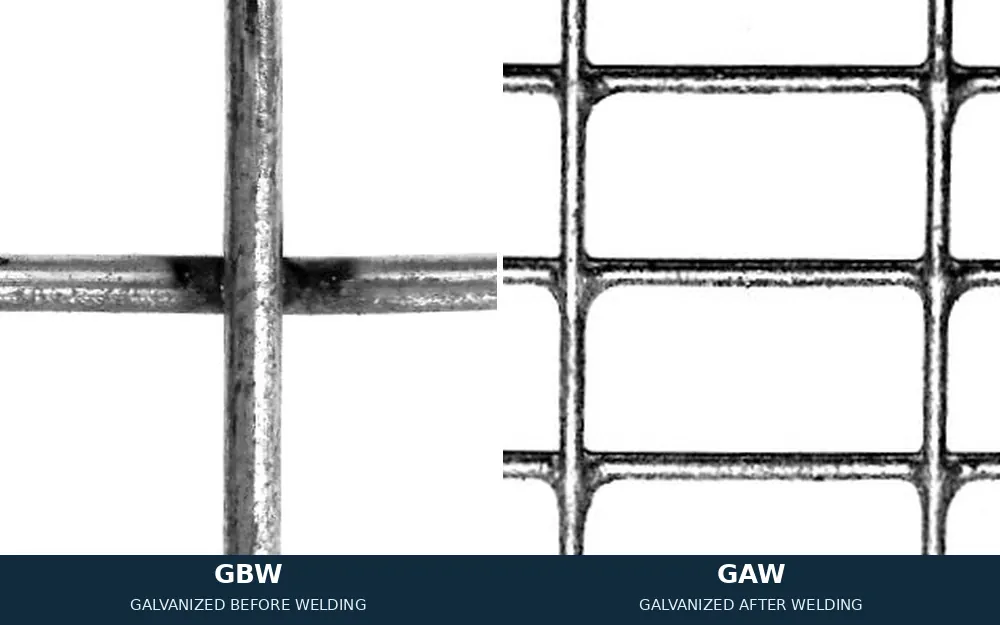
1. Compare the Processes and Weld Coverage
For welded mesh, GBW means galvanizing the wire before welding; GAW means galvanizing the mesh after welding. The practical difference is whether the welded intersection receives its zinc coating before or after it is formed.
| Buying point | GBW | GAW |
|---|---|---|
| Production sequence | Zinc-coated wire → welding → finished mesh | Wire → welding → zinc coating on the mesh |
| Weld intersections | Welding can disturb the existing zinc at the joint. | Coating is applied after the joint is formed. |
| Main inspection focus | Condition of zinc at and around welds; any specified subsequent treatment. | Coverage at welds, edges and intersections; buildup and blocked openings. |
| Cost tendency | Often the lower-cost route for comparable configurations. | Often costs more; availability and configuration affect the difference. |
| What the label does not specify | Zinc quantity, wire diameter, weld strength or service life. | Zinc quantity, wire diameter, weld strength or service life. |
Darby’s technical overview describes the process and cost tendencies and notes the corrosion-resistance advantage at GAW welded intersections. This supports the comparison, not a fixed price premium or a lifespan claim for a KUNYU order.
2. Specify Coating Evidence and Acceptance Checks
Compare the coating requirement alongside the process. A bright finish shows appearance, not zinc mass or thickness. Exposure to wet ground, salt or chemicals also changes the conditions the coating must withstand.
| Check | Record or method to agree | Why it matters |
|---|---|---|
| Zinc requirement | Required mass in g/m² or thickness in µm, its measurement basis, applicable method and sampling plan. | GBW and GAW alone do not define the coating amount. |
| Welds and coating continuity | Photos and agreed inspection of intersections, edges and packing contact points. | Local coating damage may be hidden in a general roll photograph. |
| Dimensions | Measured wire in both directions, opening, width and net length against agreed tolerances. | A coating change does not correct undersized wire or a short roll. |
| Weld integrity | Agreed test method, sample count and acceptance criteria tied to the order. | Appearance alone cannot establish joint strength. |
| Packing | Actual net/gross weights, roll dimensions, edge protection and pallet details. | Handling damage and physical packing size affect shipment acceptance. |
Use records traceable to the batch being shipped. State how defects will be handled; a repair procedure for a large steel structure is not automatically suitable for fine mesh. Neither process name establishes certification or a guaranteed service life.
3. Keep Wire, Mesh and Roll Dimensions Equal
Use one dimensional basis for both quotations. KUNYU’s listed 72 in × 100 ft roll is a GBW reference configuration with 14 gauge wire and 2 × 4 in mesh. The table converts those listed dimensions; it does not establish a matching GAW stock item.
| Field | Listed GBW reference | Basis for a GAW alternative |
|---|---|---|
| Height | 72 in = 6 ft = 1.8288 m | Keep the same height and tolerance. |
| Net roll length | 100 ft = 30.48 m | Keep the same net length. |
| Nominal mesh | 2 × 4 in = 50.8 × 101.6 mm | Match finished opening and measurement method. |
| Wire | 14 gauge; measured diameter to be confirmed | Match steel-wire diameter in both directions and the measurement basis. |
| Gross mesh area | 600 sq ft = 55.74 m² | Keep the same area before cuts and overlaps. |
Why this matters: a 72 in × 95 ft roll provides only 570 sq ft (52.95 m²), 5% less area than the 100 ft roll. At an identical price per roll, it costs about 5.3% more per unit area. That is a roll-length effect, not a galvanizing saving.
Wire size can conceal another difference: a 1.80 mm steel core has 19% less cross-sectional area than a 2.00 mm core. This calculation describes steel geometry, not a tested loss of mesh strength. Confirm the gauge system and whether diameter includes the coating.
Price per m² = comparable roll price ÷ gross roll area
Process premium (%) = (GAW price − GBW price) ÷ GBW price × 100
Calculate a process premium only after matching wire, mesh, area, quantity, packing, delivery terms and quotation date. There is no universal GAW percentage to insert into a purchase budget.
4. Choose According to Exposure and Specification
Consider GBW for a general utility or sheltered application when the finished coating condition meets the project requirement and the matched quotation offers the preferred cost. Examine the weld areas rather than accepting the word “galvanized” alone.
Consider GAW when coating the welded intersections after fabrication is an explicit requirement, or when continuity at those joints is a priority for the planned exposure. Confirm the coating level and inspect the final openings; the sequence alone is not a complete specification.
For sustained moisture, coastal exposure or chemical contact, provide the actual environment for material and coating review instead of selecting by the abbreviation alone. For PVC-coated mesh, specify the underlying zinc treatment, steel-core and finished diameters separately. Posts, fixings and enclosure gaps remain part of the complete fence design.
5. Send a Comparable Bulk-order Request
State the use and exposure; wire size and gauge convention; finished mesh opening; roll width × net length; required GBW or GAW process; coating requirement; quantities; packing; destination; and delivery terms. Request order-specific dimensional, weld and coating records.
If both processes are acceptable, request two clearly labelled alternatives against the same dimensional schedule. Approve the sample, drawing and inspection criteria before production. Keep the coating process visible on the quotation and SKU records so a repeat order is not silently substituted.
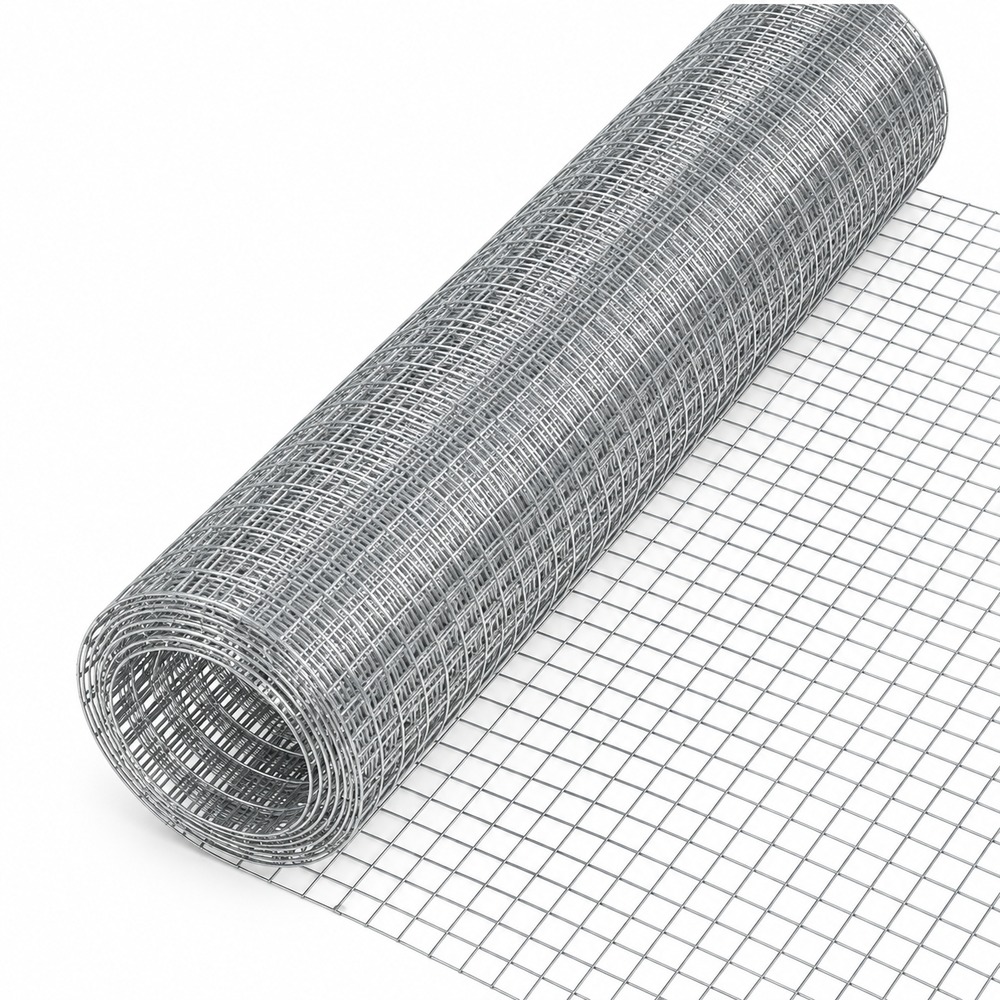 72 in × 100 ft GBW Welded Wire