

Barbed Wire
Barbed Wire Range
Galvanized and high tensile barbed wire in 12.5, 14 and 15.5 gauge with 2 or 4 point barbs for cattle, pasture and rural boundaries.
12.5-15.5 Gauge2 or 4 PointClass 3 Zinc
Source barbed wire coils and steel T posts for bulk farm and ranch orders. Compare wire-only specifications in the wholesale barbed wire range, or send a separate quantity for each product in a mixed order. KUNYU's published models include 12.5 gauge 2-point and 4-point galvanized wire, plus 14 and 15.5 gauge high-tensile 4-point wire. Listed coils are 1320 ft (402.336 m) with 5 in barb spacing. The 12.5 gauge models and 15.5 gauge model list Class 3 galvanized coating; the 14 gauge model lists galvanized options. Confirm the coating, packing and quantity for the selected SKU. Clips and fittings require a separate compatibility and supply check; complete end, corner and gate assemblies are not automatically included.
8 products available for bulk order. Every item is quoted factory-direct against your specification, quantity and destination port.
Galvanized and high tensile barbed wire in 12.5, 14 and 15.5 gauge with 2 or 4 point barbs for cattle, pasture and rural boundaries.
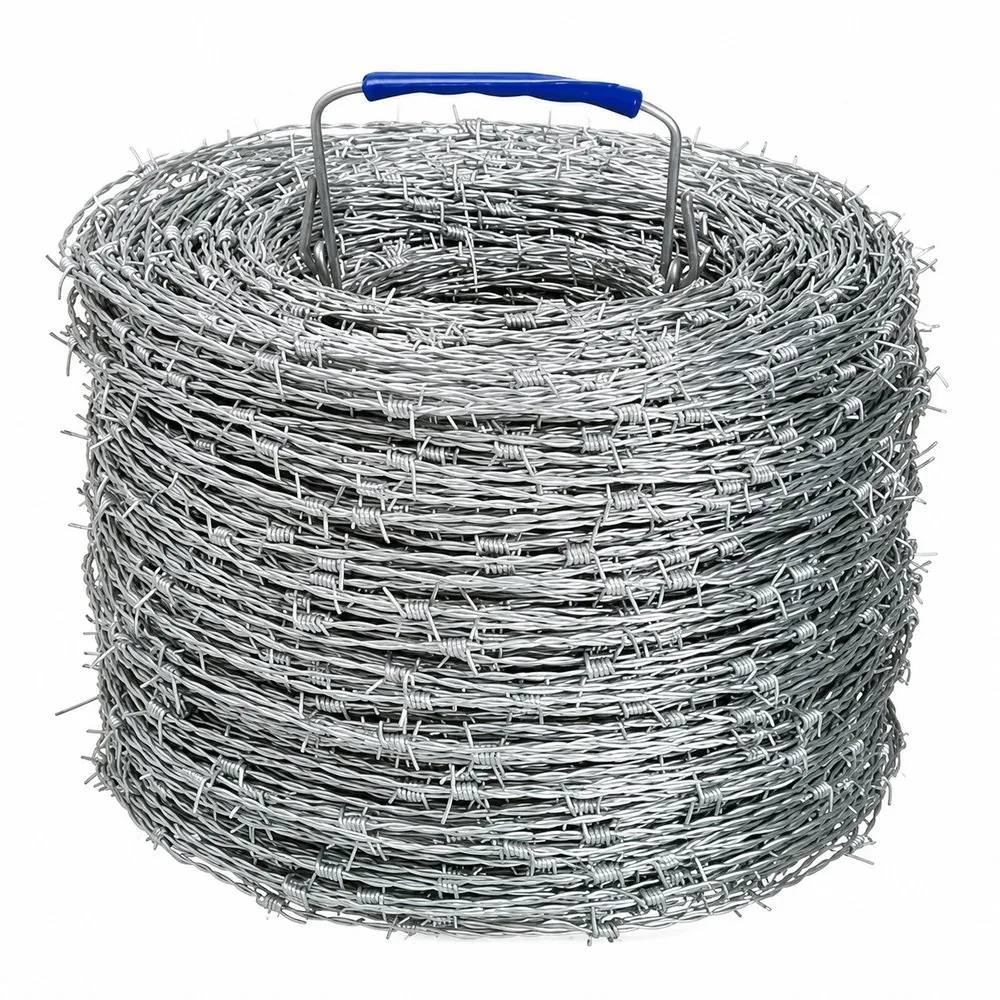
High Tensile Barbed Wire
4-point cattle and ranch barbed wire with 5 in barb spacing, 1320 ft coil and Class 3 galvanized finish.

High Tensile Barbed Wire
4-point high-tensile barbed wire with 5 in spacing and 1320 ft coils; coating level and packing are confirmed with quotation.

Heavy low-carbon galvanized wire for cattle, pasture and rural boundary fence specifications.

Traditional two-point wire for farm boundaries, pasture divisions and woven-wire topping strands.

Q235 studded T posts for fencing · green / galvanized / powder coated · bundle & pallet packing, MOQ 1 × 20GP

6 ft studded Q235 steel fence post with anchor plate and RAL 6005 green coating for farm and livestock fencing.

96 in. studded Q235 post with RAL 6005 green coating for deer, vineyard, orchard and tall boundary fencing.
Send the fence type, height, wire count, stay spacing, gauge, roll length, coating, total quantity, packing preference and destination port. For project orders send the total fence run length instead and it will be converted into rolls, posts and wire.
Barbed wire is quoted on five variables. Confirm each one and the coil count follows from the fence run length and strand count.
| Variable | Common options | What it changes | View range |
|---|---|---|---|
| Wire gauge | 12.5, 14 and 15.5 gauge | Compare actual diameter, steel grade, tensile requirement and measured coil weight; gauge alone does not establish fence strength or freight cost | 12.5 Gauge 4 Point |
| Construction | Low-carbon or high-tensile wire; coating specified separately | Match wire grade, handling and tensioning requirements to the approved design and installation instructions | 15.5 Gauge High Tensile |
| Barb points | 2 point or 4 point | Specify the number of sharp points per barb, barb spacing and wire construction; compare price on the same specification | View Barbed Wire |
| Coating | Model-specific galvanized options | Check the selected SKU, required standard, coating class or mass and order-specific evidence | View Barbed Wire |
| Coil length | 1320 ft (402.336 m); 400 m is a separate order specification | Sets the coil count for a given fence run and the number of splices in the line | 1320 ft Coils |
| Post support | 6, 8 and 10 ft studded steel T posts | Post length follows fence height and soil; spacing sets the post count per mile | View Steel T Posts |
Barbed wire fence is planned by strand count and post spacing, not by roll count. These are the figures used to convert a fence run into a purchase order.
Use the strand count from the approved fence design. Add each installed run length multiplied by its strand count, then include joining and tie-off allowances before dividing by the chosen coil length.
A 1320 ft coil equals a quarter mile of one strand. Five strands along one mile equal 26,400 ft, or 20 nominal coil lengths before joining and tie-off allowances. The example is quantity arithmetic, not a strand-count recommendation.
For one independent straight mile, a 10 ft maximum spacing gives 528 spans and 529 support positions; 8 ft gives 660 spans and 661 positions; 12 ft gives 440 spans and 441 positions. These include endpoints, not an all-T-post purchase quantity. Count end, corner, gate and brace components separately.
Select post length, grade and embedment from the approved fence height, soil and support design. End, corner and gate assemblies require their own specification. Strand count alone does not determine post length or spacing.
Confirm the usable shipment payload and physical loading layout using measured packed weights, package dimensions and route limits. Deduct shared packing and other cargo; a container size alone does not establish coil quantity.
Mixed orders of wire, posts and woven fence can be reviewed using the selected specifications, measured packed weights, package dimensions and route payload. Confirm clips and other fittings as separate quotation items. There is no fixed mixed-load quantity for every order.
For a usable loading plan, send each SKU, coil or roll length, wire gauge, coating, unit net/gross weight, packed dimensions, quantity, packing method and destination port. The quotation should show the proposed mix, payload allowance and any pallets or securing materials.
Gauge, barb, quantity and shipping answers for buyers sourcing barbed wire fence supplies in bulk.
Buy barbed wire from agricultural dealers, specialist fencing distributors or manufacturers supplying bulk orders. Local stockists can suit small or urgent purchases. For planned import and wholesale orders, KUNYU FENCING supplies 12.5 gauge 2-point and 4-point galvanized models, plus 14 and 15.5 gauge high-tensile 4-point models in listed 1320 ft coils. Compare actual wire diameter, steel type, barb spacing, coating, net coil length and inspection arrangements. Review the manufacturer and specification guide and barbed-wire production video, then send quantities, packing and destination for a quotation. Export supply does not imply US local stock or installation.
Choose a coil length that matches the required net wire length, handling plan and permitted joins. KUNYU lists 1320 ft coils, equal to 402.336 m; a 400 m order is a different length. Calculate each installed run length times its strand count, add the specified joining and tie-off allowances, then divide by the selected coil length and round up. Account for openings without wire and confirm how usable offcuts can be allocated. Send the run schedule and coil specification with the enquiry. See the coil-length calculation and examples.
Compare actual wire diameter, steel type, tensile requirements, barb construction and coating together. KUNYU publishes 12.5 gauge galvanized models and 14 or 15.5 gauge high-tensile models. Gauge alone does not determine finished-fence strength, suitable spacing or freight cost. Use the 12.5 vs 15.5 gauge guide and request the same specification from each supplier.
The point count identifies the number of sharp points at each barb. KUNYU lists 12.5 gauge 2-point and 4-point models, and 14 and 15.5 gauge high-tensile 4-point models. Compare barb spacing, wire construction, coating and coil length as well as the point count. Do not infer a fixed price, weight or performance difference from point count alone. See the barb-format buying guide.
One mile is 5,280 ft. Four strands require 21,120 ft, equal to 16 nominal 1320 ft coil lengths; five strands require 26,400 ft, equal to 20 nominal coil lengths. These are examples before joining, tie-off and cutting allowances, not installation recommendations. Account for openings and prepare the actual run schedule before rounding the order quantity. See the material calculation guide.
For one independent straight 5,280 ft run, divide by the approved maximum spacing, round up and add one endpoint position. At 10 ft the result is 529 support positions; at 8 ft, 661; at 12 ft, 441. These are total support positions, not T-post quantities. Separate end, corner, gate and brace assemblies; shared corners in a closed boundary change the count. Obtain approval for spacing and use the layout-based quantity guide.
High tensile describes wire strength characteristics; galvanized describes a coating. Compare low-carbon and high-tensile constructions with the coating specified separately. Select the wire grade, diameter, barb pattern and installation requirements for the approved fence design. The words high tensile alone do not establish post spacing, finished-fence strength or service life.
KUNYU FENCING's minimum order is one 20ft container (1 × 20GP). The roll or post quantity depends on the selected specifications and packing. Different models or products can be submitted for mixed-container review; the allocation, compatibility and loading plan must be agreed in the quotation.
KUNYU can review mixed orders of barbed wire coils, woven fence and steel T posts. Confirm any clips or fittings separately. The combination must be calculated from the ordered specifications, measured packed weights, dimensions, shipment payload and destination limits. Ask for a model-specific packing list and loading plan rather than a generic coil or post quantity.
Specify the coating material, applicable standard and required class or coating mass for the selected wire and environment. KUNYU's 12.5 gauge 2-point, 12.5 gauge 4-point and 15.5 gauge high-tensile models list Class 3 galvanized coating; the 14 gauge high-tensile model lists galvanized options. Confirm any alternative coating and supporting test scope in the quotation. Do not assume every gauge has the same coating or a guaranteed service life.
Use these technical guides to narrow the specification before requesting a factory quotation.
Review related product ranges when preparing a mixed order. Quantities and shipment feasibility depend on the selected specifications, measured packing data and destination.
Barbed Wire Buying Guide
Compare barb format, quotation details, coil basis and the questions distributors should confirm before ordering.
Read the Buyer Guide